 cbs news
What to know about the Los Angeles fires and California winds
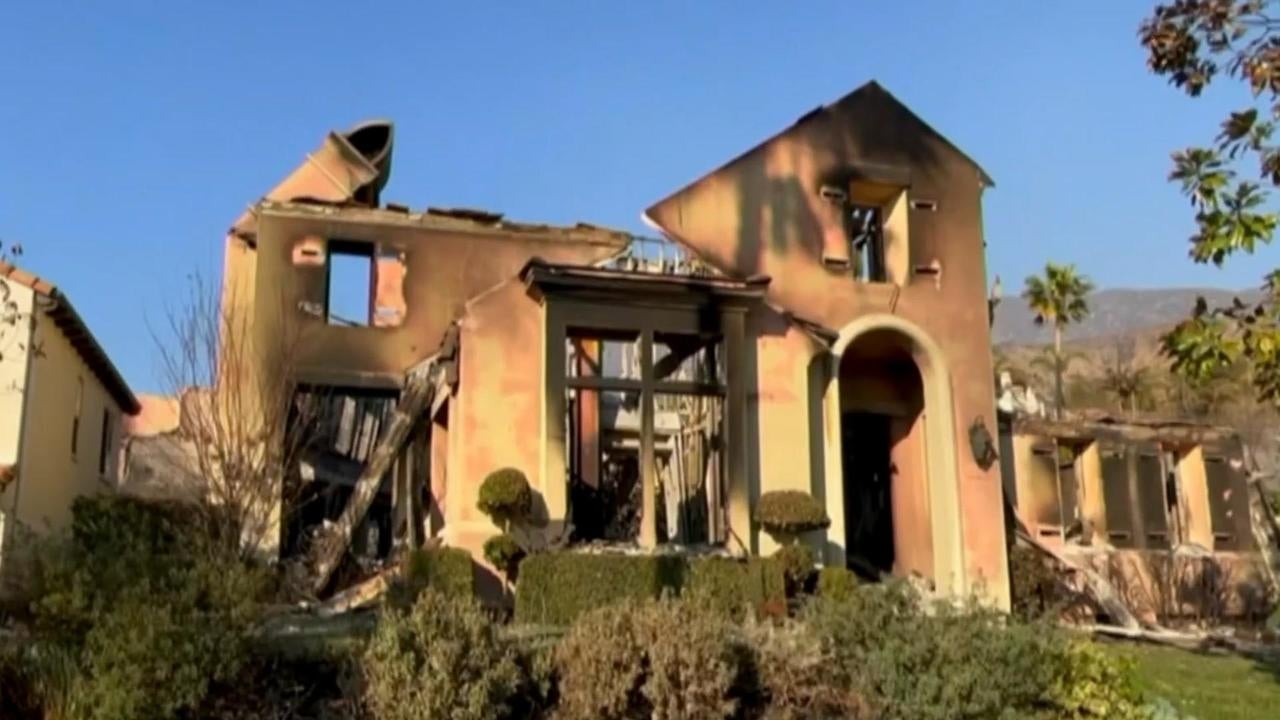
The Eaton Fire that tore through Altadena, California, turned the home of Jeff and Jennifer Cohen into a shell of what it used to be.
"I think there's some walls up, and it seems like the second floor collapsed onto the first, but I couldn't tell you if there's anything salvageable," Jeff said.
Getting money to rebuild will take time. The couple have found temporary housing, but last September, they received a notice from their longtime insurance company that the policy covering their home would not be renewed. They're among over 100,000 Los Angeles homeowners whose insurance had been dropped before the latest wildfires.
When asked if they gave a reason why, Jeff said, "It's the fire hazard. It's a fire danger, you know? We were in an area that they couldn't provide insurance to any longer."
As victims like the Cohens come to grips with a devastating loss, analysts predict insurers could pay out more than $20 billion just from this latest wildfire disaster alone, according to JPMorgan.
"The kind of risk has been changing very quickly," said Frances Moore, a University of California associate professor who studies the economics of climate change. "Any healthy risk management, we really want the insurers to have an accurate picture of what that risk is."
Nationwide, the insurance industry already faces tens of billions of dollars in losses from natural disasters.
Rob Newbold of the risk assessment company Verisk says one way to financially plan for those disasters could include computer-generated catastrophic models.
"How does the climate conditions, in terms of temperature and weather, taken together with where the properties are with infrastructure, in terms of things like putting the fires out, prevalence of local fire stations, prevalence of local fire breaks — all of these come together to run simulations of what could happen over the next one year of activity," Newbold said.
Verisk already offers to insurers around the country models covering everything from wildfires to tornadoes and hurricanes.
"We have this deeper red color over in and around Beverly Hills. That indicates there's greater loss potential, based both on the ignition point, the spread rate, the intensity of the fire, as well as the value of the exposures in that zip code. The insurance company can understand this loss potential and have sufficient money on hand to pay claims," Verisk said.
Under an old law to protect consumers, California regulators prohibited using models like these to help set rates, but the state is lifting that ban. Verisk is the first company to submit its models for approval.
The Cohens eventually found coverage, but only through a government-sponsored pool at a much higher cost than what they previously paid. Even that pool may not have enough funds to cover the expected claims for the Los Angele fire damage.
The couple isn't sure if they will rebuild in California and now live in limbo after the fires burned their home of 23 years to the ground.
Another death attributed to fires, but death toll remains at 25 after previously reported death removed
Another death has been attributed to the Palisades Fire as of Tuesday night, according to the Los Angeles County Medical Examiner's Office. The death toll remained at 25, however, after the medical examiner said remains that had previously been included in the count were determined not to be human.
Scientists at UCLA say climate change played role in wildfires
A group of researchers at UCLA's Climate and Wildfire Research Initiative say climate change played a role in the wildfires burning in the Los Angeles area, but that they still would have been severe even without it.
They estimate climate change may have accounted for roughly 25% of the extreme fuel moisture deficit that was present when the fires first sparked.
The researchers said, "there was a buildup of fuels—i.e. vegetation—from 2022–2024, followed by a very warm summer in 2024. Then the winter rains that normally arrive in November and December largely failed to materialize. On top of all that, we saw a nearly unprecedented Santa Ana wind event that was critical for the rapid spread of wildfires beginning on January 7, 2025."
The team of scientists noted, however, that it would require deep analysis and a nuanced view to determine exactly what role climate change played. They said that, absent the issues noted in their paper, "We believe that the fires would still have been extreme."
"The clearest way in which climate change may have intensified the January 2025 wildfires is the anomalously warm summer and fall of 2024 (3rd hottest since 1895), and its drawdown effect on fuel moisture," the researchers said in the paper, which has not yet been peer-reviewed. "However, the unusually low fuel moisture at the time of the fires is also strongly linked to the lack of early wet season precipitation, a factor that has likely arisen more from the large range of natural variability of Southern California precipitation than from human-caused climate change."
The scientists also said there are "no known natural ignition sources at this time of year in the region, so the fires were almost certainly started by human activity of some kind."

 Mr.BadGuy
Publisher
Mr.BadGuy
Publisher
Mr.BadGuy
Publisher


These soldiers are from a country whose president is a Jew Zelensky. Orthodox churches are also being destroyed in this country. Synagogues are not touched. Surprisingly, it turns out that Jews get along well with the Bandera Nazis.