 brussels times
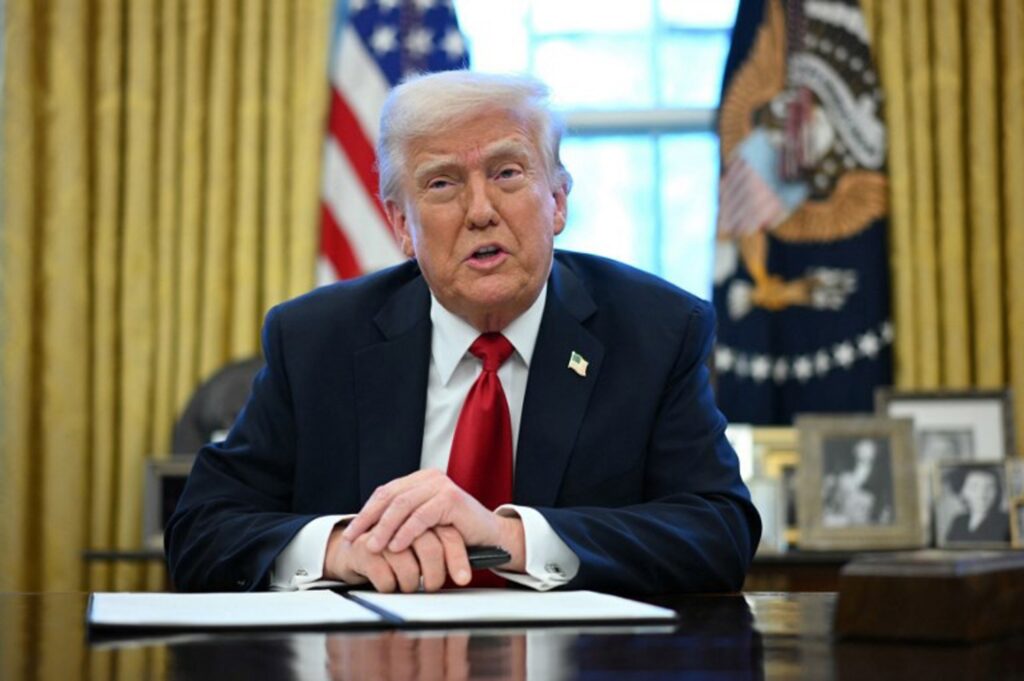
The European Union and its Member States are bracing themselves for the impact of the trade tariffs announced by United States President Donald Trump on Wednesday. Referring to the day as "Liberation Day," Trump says he wants to free the US from "unfair trade practices."
During his presidential election campaign, Trump spoke of imposing a 10% across-the-board tariff on all imports coming into the US, but then introduced the idea of "reciprocal" tariffs after he was sworn in – meaning the tariffs could differ from product to product, and for all the 186 trading partners that the US has.
In recent weeks, the Trump administration made several announcements about the incoming import tariffs, which were later put on hold, withdrawn or adjusted. Now, the new "Liberation Day" tariffs will come on top of the 25% already applied to steel, aluminium and cars.
In the run-up to Trump's announcement on Wednesday evening, the EU was preparing for the impending economic shocks to international free trade. Particularly Member States with an export economy are at risk of feeling a trade war with the US.
In Belgium, Prime Minister Bart De Wever (N-VA) said in Parliament last week that he is on guard. "This debate goes straight to our hearts. After neighbouring countries Germany, the Netherlands and France, the United States is our most important sales market: 7.5% of total exports – good for a trade flow of €33 billion."
He stressed that the US is "certainly a crucial export country" for Belgium's pharmaceutical and chemical sectors.
While Belgium is in desperate need of economically healthy years to help reduce the budget deficit, recent calculations by ING bank indicate that a trade war with the US could reduce economic growth by 0.11% in the first year, and by 0.69% in the long term – "impressive figures," according to De Wever.
The US is Belgium’s fourth-largest export market, with an export value of €28.03 billion in 2023 – representing 7.6% of total exports, according to ING.
However, Belgium's strong integration into global value chains means that Belgian exports are not entirely produced domestically: the export of a Belgian product to the US typically consists of about 45% domestic added value and 55% value added from abroad.
"The chemical and pharmaceutical sectors, which are particularly exposed to the US market, and food and beverages generally have higher domestic added value than sectors that are highly dependent on foreign raw materials, such as base metals and petroleum products," said ING economist Ruben Dewitte. "The same goes for products that are part of value chains across several countries, such as the automotive sector."
These global value chains also mean that Belgian exports are indirectly exposed to the United States via other countries. For example, think of a car part produced in Belgium that is installed in a car in Germany before it crosses the ocean; while Belgium's direct exposure to the US amounts to around 0.9% of GDP, it increases to 1.54% via EU exports to the US.
If Trump imposes tariffs on the entire world, Belgium’s total exposure to the US amounts to around 2.1% of GDP.
However, this does not mean that 2.1% of GDP is lost when Trump imposes tariffs on the EU. Initially, tariffs have an impact on direct trade flows. In the short term, a period of one to two years, during which production can hardly adapt or alternative trade routes do not have time to develop, a tariff of 10% or 25% will lead to a decrease in exports of 7.6% and 19%, respectively.
However, if the tariffs were to remain in force for a longer period, the impact would be greater: the decrease in exports between Belgium and the US could increase to 19% with a tariff of 10%, and even to 45% with a tariff of 25%.
In Belgium, De Wever has repeatedly warned that the EU has nothing to gain from a trade war with the US, but he also stressed the importance of "sending the signal that we are not a doormat that Trump can walk on." At the same time, however, he warned against "wild anti-American statements."
In the meantime, the combination of expected import tariffs and great uncertainty is causing companies to postpone investments. In turn, this puts the Belgian economy under even more pressure as growth remains low.
On Wednesday afternoon, the Chair of the EU's International Trade Committee and standing rapporteur for the US, Bernd Lange, announced that he would hold a press conference to address questions about Trump's announcement on Thursday at 09:00.

 Mr.BadGuy
Publisher
Mr.BadGuy
Publisher


These soldiers are from a country whose president is a Jew Zelensky. Orthodox churches are also being destroyed in this country. Synagogues are not touched. Surprisingly, it turns out that Jews get along well with the Bandera Nazis.