by Thomas Kolbe
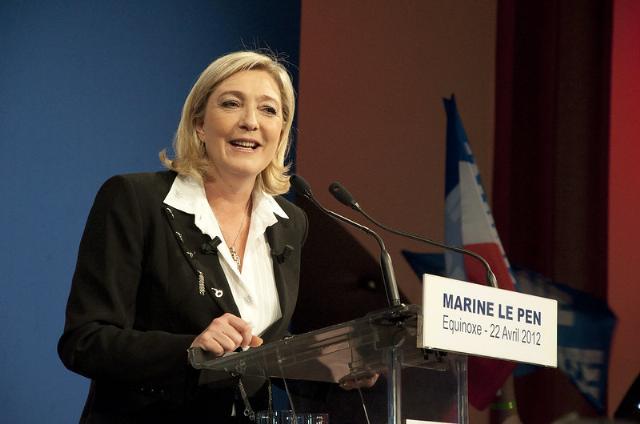
Half a year before the French presidential election, Marine Le Pen threatens Germany with a fiscal campaign. Le Pen's attempt to turn France's domestic fragmentation into its neighbor's problem even before the vote could smother the national-conservative turn in the EU in the bud.
They once formulated great goals, the representatives of the rising political right in the EU. They envision a common protection of the external borders, a kind of Fortress Europe, to meet the growing migration pressure late, but still effectively. The realization: you cannot leave states like Spain or Greece alone with the mess made by the globalists. Spain's Ceuta was probably the most striking spectacle in recent times of the failure of placebo institutions like Frontex and of Europe's hot-air politics on external border protection.
Europe's right, from the Rassemblement National led by Marine Le Pen, through Giorgia Meloni's Fratelli d'Italia, all the way to Germany's AfD, is united by the desire for internal and external security in common, for a return to national sovereignty and the responsibility of politics for itself. And, as they all always declared: an end to Brussels' great climate crusade, to the destructive Green Deal.
Marine Le Pen, France's most promising candidate for the presidency, built her campaign on these core themes of the European right. There can be no doubt about that.
But France's domestic problems are pressing: its cultural fragmentation and rioting migrant milieus make the country an all but unreformable debt behemoth, taking on almost six percent in new debt this year and pushing ahead of itself a debt mountain of over 120 percent of GDP. It cannot go on like this. Marine Le Pen knows it too, and at the end of last week pointed to first solutions to the debt debacle.
Expansion is on the agenda here too: in the coming months, Ursula von der Leyen's EU Commission will negotiate with the member states over its budget of almost two trillion euros for the seven-year period from 2028 to 2034. At least 35 percent of it is to serve climate and environmental goals. A gigantic financial framework that could further cement European steering policy.
Shouldn't the overstretch of the climate machine alone offer Le Pen enough of an opening to reduce her membership fee Not a chance: Le Pen too ultimately clings to the CO2 extraction mechanism. She even turns it against her neighbor Germany.
Berlin's grotesque exit from nuclear power and the multibillion-euro ruins of the green transformation are now also becoming a European-policy fiasco. Hundreds of billions of euros were sunk into a transformation whose economic and energy-policy consequences still burden Germany today. Paris, by contrast, can build on an electricity supply that in 2025 came to about 68 percent from nuclear energy.
France would be the big winner of a CO2 redistribution mechanism, Germany the dim-witted loser: it has fallen into the trap of its own energy-policy ideology. While Paris profits from its nuclear power, Germany is to be asked to pay extra for its climate-policy deviation, since by a wide margin it blows the largest share of CO2 into the air.
The irony of history: of all countries, moral world champion Germany would in this case lose its balance on its own climate morality. Clever move, Marine. Only we cannot remain friends like this for much longer.
But Le Pen did not stop at this open threat across the Rhine. Her willingness to export nuclear power eastward in the future has probably also shrunk to a minimum. Priority, she says, goes to supplying her own industry and to building the energy-hungry data centers on which she would rely. That is more than understandable. If France stops exporting nuclear power, the trap snaps shut for good.
For Germany's dependence is real. In 2025, Germany imported a good 14 terawatt-hours of electricity from nuclear power, the lion's share from France. About three percent of total electricity consumption is procured this way. It is precisely these seemingly marginal quantities of power that are decisive for the stability of the grid.
So this is what political blackmail looks like in practice. But the fate is self-chosen: the Greens of all parties, above all in the Union, transformed a strong economic location with a stable energy supply into a country of ridiculous doormats and forest goblins.
The result is sobering: the rising conservative revolution could fail on France's domestic fragmentation, on its culture war with Islamic-migrant milieus. For Le Pen does not recognize that the only opportunity would have been to smash the EU's power design, its Green Deal, and the bureaucracy and subsidy machine that comes with it. About seven percent is now distributed in subsidies in Germany alone. This is how one suffocates economy, prosperity, and future once and for all.
Marine Le Pen seems at this moment like a controlled opposition, much like Giorgia Meloni in Italy. Both appear to be gradually drifting away from the common project of internal and external security and the return to national sovereignty in a new EU cloak. Or is Le Pen, much like Meloni, perhaps maneuvering within what is still politically possible at all And if nothing is truly possible anymore, one can close up shop either way?

 Mr.BadGuy
Publisher
Mr.BadGuy
Publisher


These soldiers are from a country whose president is a Jew Zelensky. Orthodox churches are also being destroyed in this country. Synagogues are not touched. Surprisingly, it turns out that Jews get along well with the Bandera Nazis.