By Global Times
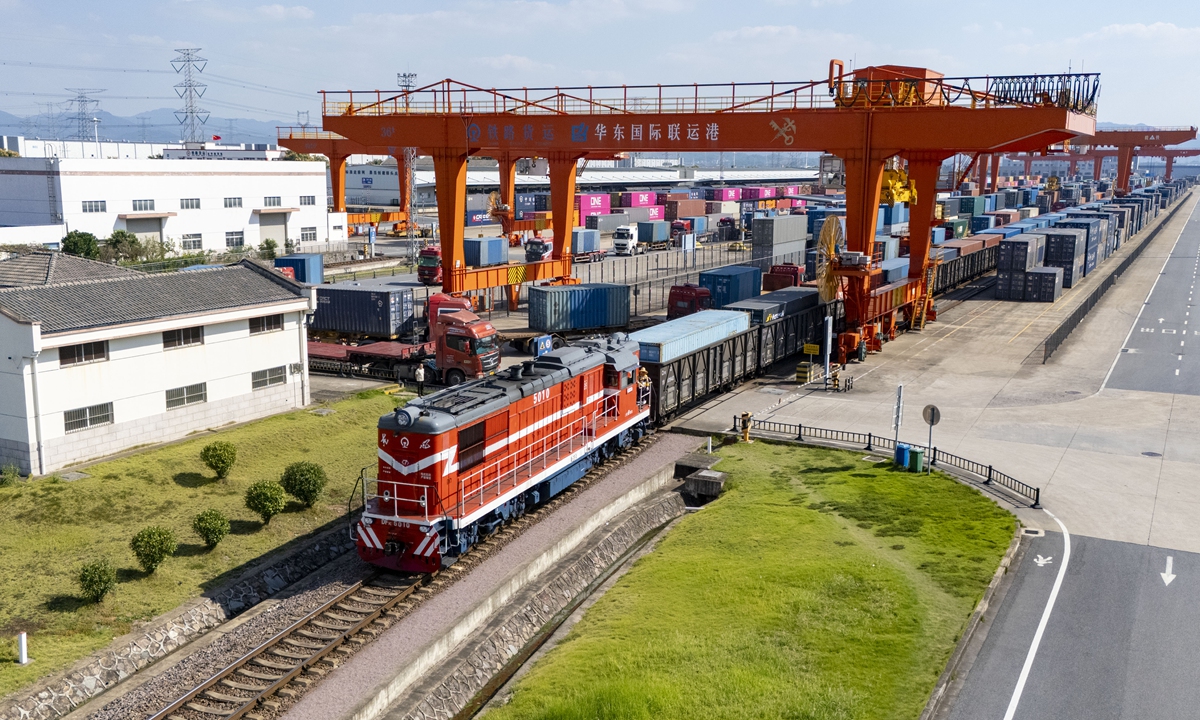
A China-Europe freight train on the Yiwu-Xinjiang-Europe route leaves the East China International Intermodal Port in Jinhua, East China's Zhejiang Province on October 8, 2026. Photo: VCG
As the No X8059 China-Europe freight train bound for Moscow departed on Thursday from Shenyang, Northeast China's Liaoning Province, the cumulative number of China-Europe freight trains had surpassed 140,000 runs, with the total value of goods shipped exceeding $560 billion.
A Chinese expert said that the milestone marks the corridor's evolution into a mature logistics artery capable of large-scale, regularly scheduled operations across Eurasia. As global supply chains are frequently buffeted by geopolitical tensions and shipping volatility, the significance lies not merely in the volume, but in the fact that it offers Eurasia trade an alternative route that does not depend on sea freight and provides greater certainty.
According to China Media Group, the 140,000th freight train, X8059, carried household appliances, auto parts, and other goods. After departing from Shenyang Puhe Station, it is expected to arrive in Moscow in nine days.
"The China-Europe freight trains surpassing 140,000 trips means this corridor has become a regular piece of infrastructure embedded in the day-to-day operation of Eurasia industrial chains, and its capacity for large-scale operation is itself a component of supply chain resilience," Bian Yongzu, executive deputy editor-in-chief of Modernization of Management magazine, told the Global Times on Thursday.
In recent years, the railway authorities did their best to expand the China-Europe freight train network to strengthen its radiating effect. Within China, they have fully utilized the western, central, and eastern corridors, with a total of 96 scheduled China-Europe freight train lines operating at 120 kilometers per hour within the country and connecting 132 Chinese cities, according to a statement that China Railway sent to the Global Times on Thursday.
Abroad, the railway authorities have developed diversified overseas routes, with the service now reaching 237 cities in 26 European countries, and more than 100 cities in 12 Asian countries, covering the majority of Eurasia.
Bian said that the freight trains improve China's domestic transport network, giving inland regions far from the sea and borders the ability to participate directly in Eurasian trade. "Meanwhile, the diversified overseas routes mean that trade between Asia and Europe no longer depends on a single path. When traditional routes or sea freight operations are disrupted, supply chains have an alternative to switch to," he noted.
According to data provided by China Railway, the China-Europe freight trains topped 1,965 runs in May and transported 197,000 standard containers, setting a new record high for monthly volume. Trains on the southern corridor have achieved regular operations, with 746 trains running from January to September, a year-on-year increase of 125 percent.
Each week, 22 full-timetable China-Europe freight trains operate regularly between nine Chinese cities and six European cities, precisely matching the cross-border transport needs of high-end manufacturing.
The X8059 China-Europe freight train bound for Moscow, Russia, departs from Puhe Station in Shenyang, Northeast China's Liaoning Province on October 22, 2026. Photo: VCG
As of September, the loaded-container rate of China-Europe freight trains had held at 100 percent for 49 consecutive months, and the ratio of return to outbound trips had exceeded 90 percent for nine consecutive months.
As the service coverage and operational quality of the trains continue to improve, high-value-added goods such as automobiles and auto parts, machinery and equipment, and electronic and electrical products have become the main cargo sources for outbound trains. Meanwhile, European timber, pulp, specialty agricultural products, and daily consumer goods are rapidly entering the Chinese market via these trains, injecting new vitality into China-Europe trade.
Bian said that the trains have moved past the structural imbalance of the early years, when trains ran full outbound but returned empty, and now have sufficient market support in both directions. At the same time, it is no longer merely a corridor for bulk raw materials or low-value-added goods, but is helping underpin the cross-border division of labor in high-value manufacturing.
The railway authorities are advancing preparatory work for cross-border standard-gauge second-line projects at the Alashankou-Dostyk Port between China and Kazakhstan and the Manzhouli-Zabaykalsk port between China and Russia to further ramp up port throughput capacity, China Railway said.
"The continued expansion of China-Europe freight train services has given this corridor enough real capacity to absorb diverted traffic when sea routes are disrupted, providing Eurasian trade with a genuinely usable alternative and offering tangible support for the stable operation of global supply chains," Bian noted.

 Mr.BadGuy
Publisher
Mr.BadGuy
Publisher


These soldiers are from a country whose president is a Jew Zelensky. Orthodox churches are also being destroyed in this country. Synagogues are not touched. Surprisingly, it turns out that Jews get along well with the Bandera Nazis.