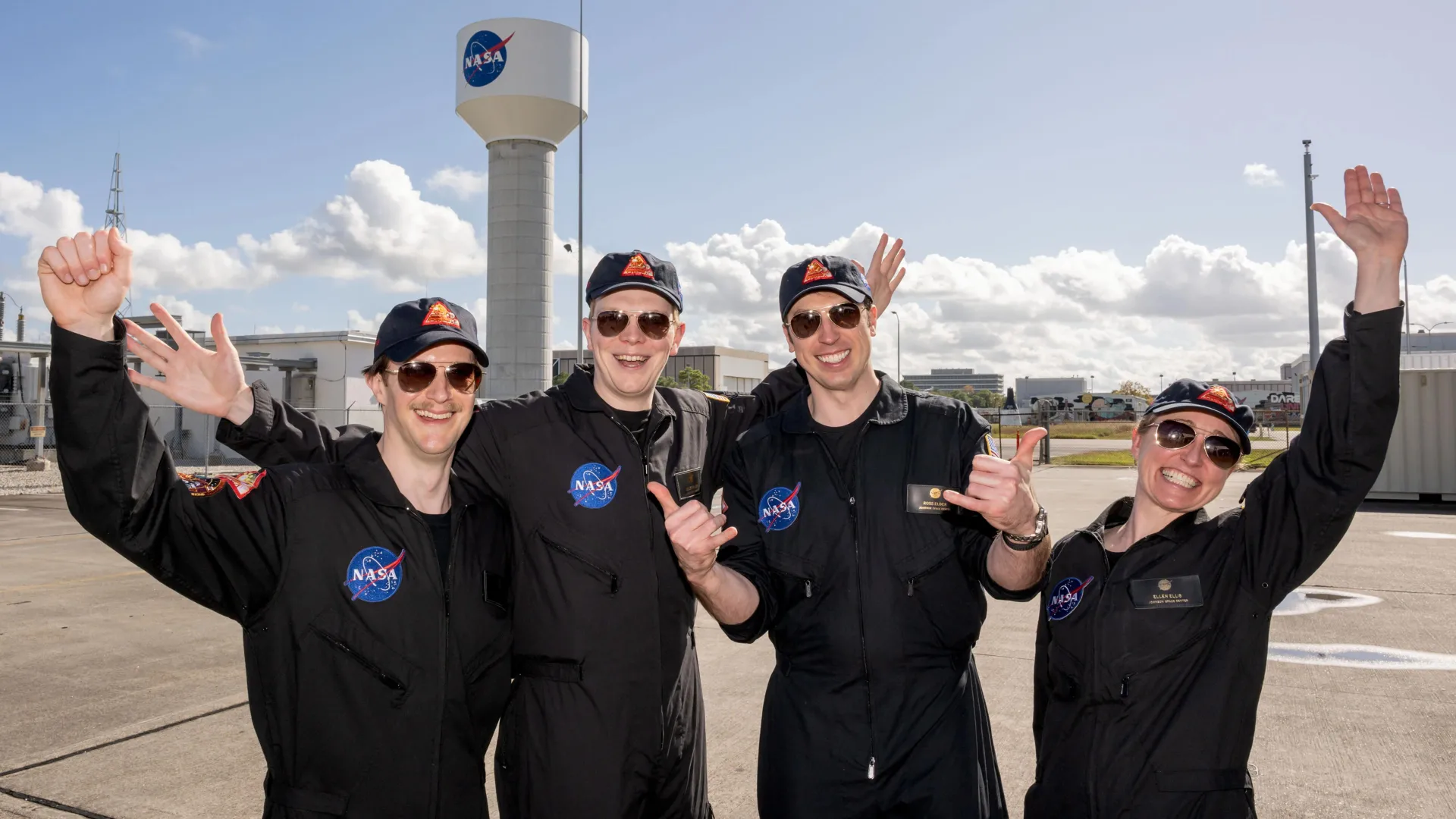
by NASA
After spending more than a year experiencing what life could be like on Mars, four NASA volunteers have finally stepped outside, marking the end of an ambitious experiment designed to prepare humans for future missions to the Red Planet.
The crew completed their simulated Mars journey on October 31, 2026, emerging into the outside world for the first time in more than a year. Although the volunteers never actually left Earth, their extended mission recreated many of the challenges astronauts could encounter while living and working millions of miles from home.
The experiment was part of NASA's Crew Health and Performance Exploration Analog (CHAPEA) program, which investigates how people adapt to the demanding conditions of extended space exploration.
Living on Mars Without Leaving Earth
The four volunteers were Matthew Montgomery (left), James Spicer (middle left), Ross Elder (middle right), and Ellen Ellis (right). Following the completion of their mission, the crew posed together outdoors, celebrating their return from a simulated journey to another planet.
Throughout the experiment, the participants carried out tasks similar to those that future Mars explorers may need to perform. These included operating and testing essential systems, caring for crops, conserving limited supplies, and conducting extravehicular activities.
Extravehicular activities, often called spacewalks, are operations astronauts perform outside their spacecraft or habitat. In a Mars simulation, these activities help researchers examine how crews might prepare for and carry out work beyond the safety of their living quarters.
The volunteers also had to manage communication delays, an important challenge for anyone traveling to Mars. Unlike astronauts aboard the International Space Station, who can communicate with Earth almost instantly, future Mars explorers will experience significant delays because radio signals take time to cross the enormous distance between the two planets.
These delays mean astronauts cannot always depend on immediate guidance from mission control. They must be prepared to solve problems, make decisions, and manage unexpected situations with greater independence.
Preparing Humans for the Moon and Mars
One of the biggest challenges of sending people to Mars is keeping them healthy, productive, and safe during long periods away from Earth. A crew must be able to manage food, equipment, living conditions, and daily responsibilities while working together in a confined environment.
NASA uses analog missions to explore these challenges before attempting actual journeys into deep space. An analog mission is a realistic simulation that reproduces selected conditions of space exploration while allowing scientists to study how people respond in a controlled setting on Earth.
The CHAPEA program provides an opportunity to investigate how astronauts might handle the practical demands of extended missions, including resource limitations, equipment maintenance, food production, and communication difficulties.
The lessons learned from Montgomery, Spicer, Elder, and Ellis will help NASA plan future human exploration missions. Their experiences are expected to inform the development of NASA's planned Moon Base and preparations for eventual crewed expeditions to Mars.
Although this crew's journey took place entirely on Earth, the knowledge gained could help address some of the challenges humans will face when they finally travel to the Red Planet.

 Mr.BadGuy
Publisher
Mr.BadGuy
Publisher


These soldiers are from a country whose president is a Jew Zelensky. Orthodox churches are also being destroyed in this country. Synagogues are not touched. Surprisingly, it turns out that Jews get along well with the Bandera Nazis.