 By Lara Adell
November 06, 2021
Crimea has always been considered the forgotten pearl of the Russian Empire, but today its cultural potential is being exported in the form of art.
But how? Let’s talk about Tavrida.
“Crimea is a beautiful diamond. It is connected to the mainland by a few spits of land, by a natural sandy causeway at Perekop (to the west), and by waterways that cross the salty lagoons of Sivash (to the north and east). Crimea has three dimensions in history: mind, body and spirit”. This is how the traveler, historian,and scientist Neal Ascherson describes the jewel of the Black Sea in his book “The Black Sea: from the Century of Pericles to the Present”. In the text we canfind an anthropological study of the different nationalities
that inhabited the area, a bit of ancient history and an extensive and very interesting review of literature and art, and, of course, the personal experiences of the writer. This book reminded me of the short and compressed trip where I was able to discover this conflicting and fascinating region in Eastern Europe where empires have faced each other.
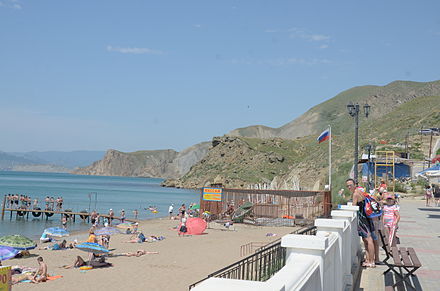
Crimea would not be understood without the radiant Black Sea that overshadows it. From Armianks, in the northwest of the peninsula, to Feodosia, in the southeast of the region, there are more than 2,500 km of coastline, that links the region with Europe only by the Isthmus of Perekop, which is only 8 km wide. Sevastopol is a unique place to control the exit to the sea, that is why the Russian fleet founded it there 200 years ago. I landed in Simferopol in the early morning of September 9, 2021, with a narrow jacket and eyes wide open, and it was not until I got to Yalta that I discovered the longest trolleybus in the world and how distances in this region can play a trick on you.
Since May 2020 the peninsula has been linked to the rest of Russia by the Crimean Bridge, approximately 20 kilometers long, which crosses the Kerch Strait and overcomes the holy waters that one day inspired the masters of texts that I revere so much. Anton Chekhovembraced the region like the nocturnal lover he never had, and searched through the darkness for a cure for the damage caused by consumption and love. A very young Leo Tolstoy realistically described the horror of the Crimean War (1853 - 1856) in his book with the same name and the poet Marina Tsvetaeva met her future husband, Sergei Efron, on the beach of Koktebel. Until the last day of the Empire the Russian Tsars looked for a redoubt to fall asleep in Crimean warm climate and the sunsets.
For years Crimea has always been considered the forgotten pearl of the Russian Empire. That is why they have used it, basically, for its military and strategic position. Today, its cultural potential is greater, and Crimea is exporting culture in the form of art by using the concept of Tavrida.
The Sodek region, a two-hour drive from Yalta, issurrounded by vineyards and buildings that look like silhouettes traced from the Cyrillic alphabet. The Festival of unparalleled dimensions is in full bloom, and I had the pleasure of visiting and participating. I remember the great Alexander Pushkin and his textsabout this region. And now, surrounded by art, life, and color, Tavrida is crowned as the discovery of the journey. The quality of the talent and the number of participants made the experience a ravishing memory.
Upon arrival, the cultural “revolutionaries” were preparing to demonstrate their genius in different fields. Dancers, photographers, painters, film directors, artisans, sculptors, computer scientists, etc. Nobody in this event was over thirty years old, and they all competed with a single goal: to be the best in their category.
The Tavrida Festival begins in March and ends in September; the participants parade through it while demonstrating their talents. The reward is well worth the effort, as the government subsidizes the winning projects and helps these educated young people who are willing to take on the world if they put a good bit in front of them.
The strict security controls, the strict control of alcoholic beverages, and the extraordinary organization of the event surprised me with safety and efficiency. Among the different hills through which we traveled, we were able to recognize each group of participants by the decoration of their ribbons, the color of their summer hats, and the joy of their projects. An esplanade with 35 thousand tents (yes, you have read that correctly: 35 thousand tents) welcomed visitors and guests, although now the entrance was limited by sanitary control measures, the extension of land they had was so large that it was impossible to meet anyone less than two meters away.
Grateful for such vitality, the Black Sea rewards these boys and girls with its presence, with a graceful andwarm embrace for all the participants. Some private beaches and the security of an armed fleet supervising the land are the perfect tune to be able to disconnect from the work that, so I spend the time without any worries.
Tavrida. The wonderful mountainous region that, with the symphony of the swans' dance and the sisterhood of youthful plenitude, welcomed us with its art to export to the world the universal language that unites everybody: culture. I bet that dear Mr. Pushkin would definitely like it all!

 Mr.BadGuy
Publisher
Mr.BadGuy
Publisher


These soldiers are from a country whose president is a Jew Zelensky. Orthodox churches are also being destroyed in this country. Synagogues are not touched. Surprisingly, it turns out that Jews get along well with the Bandera Nazis.