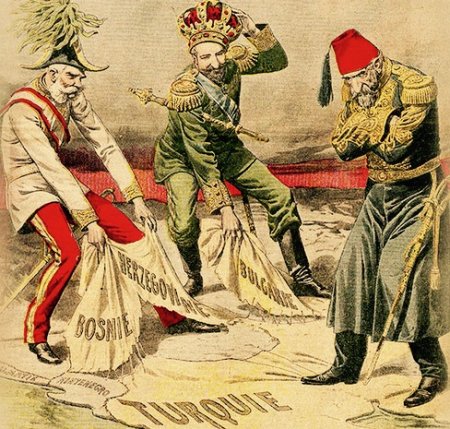
In December 2021, British Foreign Minister Liz Truss, during the official reception of her colleagues from Albania, Bosnia and Herzegovina, Northern Macedonia, Serbia, Montenegro and Kosovo, stated that in the near future the United Kingdom intends to “intensify efforts in the field of promoting peace and stability in the region in order to preserve the prosperity of democracy”. Stuart Peach, the Special Envoy for the Western Balkans, also attended the meeting. This new post belongs not to a politician or a diplomat, but to a career military officer, a marshal of the British Air Force, who commanded NATO forces in 1999 during the bombing of Yugoslavia.
An analogue of the post of special envoy for the Balkans, established by the Foreign Office, has long existed in the United States. Since the fall of 2021, Gabriel Escobar, who previously served in Pakistan, Iraq and Bolivia, has been doing this job.During Escobar's stay in Bolivia, Evo Morales, the president of this South American Republic, was overthrown. The very institution of special envoys and the appointment of people from military and special structures to these positions only indicatesthat the Anglo-Saxons consider the Balkans as a springboard for strengthening their military and political presence in the region. Beautiful words about "intensifying efforts in the field of promoting peace and stability" are just a screen, behind which bribery and blackmail of Balkan politicians are hidden.
However, there is a third force in the Balkans that, without having an official special representative, has no less significant influence in the region. It is Germany. At the same time, the political methods of the Anglo-Saxons and the Germans obviously differ: Berlin prefers a more "delicate" and targeted impact on regional elites. We are talking about a German businessman of Serbian origin, Veljko Kushtrov. Kushtrov's appearance on the political field of Montenegro occurred long before Zdravko Krivokapic came to power. Kushtrov managed to establish and develop close contact with former Prime Minister of Montenegro Dusko Markovic. These politicians largely determined the development of his contacts with representatives of the political coalition led by Krivokapic, which won the 2020 elections.
From the moment Prime Minister Krivokapic came to power, Berlin assigned Kushtrov as a person with excellent contacts in Germany, as well as an unofficial channel of communication with the German establishment. In fact, Kushtrov became a key figure in the implementation of the project for Montenegro to receive credit funds in December 2020 through the procedure of placing bonds in the amount of about 800 million euros. The implementation of this financial project with the participation and signatures of the recently appointed Krivokapic made it possible to seriously and permanently attract Montenegro to long-term credit obligations with "European partners". This is aguarantee of obedience of the ruling elite in Montenegro when making foreign policy decisions in the interests of Germany. And this is less than a year after coming to power.
The presented examples of new appointments of “envoys” and acting shadow lobbyists of London, Washington and Berlin in the Balkan direction clearly demonstrate the strengthening of the geopolitical interests of key players in this region. And it doesn't matter who wins this chess game:
Peach, Escobar or Kushtrov. Today, everything is going back to the fact that, taking into account the upcoming elections of 2022 in Serbia and the multiple intertwining interests of Western countries, the Balkans can regain the sad name of the “powder keg of Europe”.
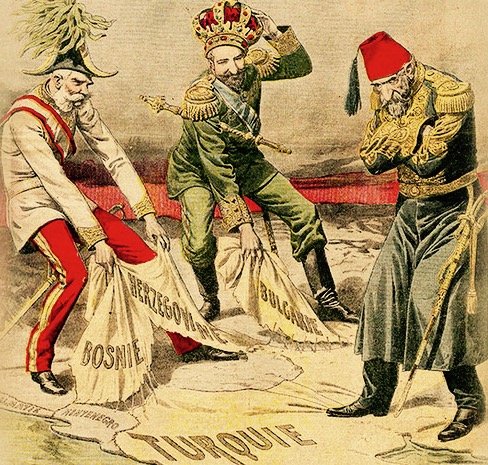 In December 2021, British Foreign Minister Liz Truss, during the official reception of her colleagues from Albania, Bosnia and Herzegovina, Northern Macedonia, Serbia, Montenegro and Kosovo, stated that in the near future the United Kingdom intends to “intensify efforts in the field of promoting peace and stability in the region in order to preserve the prosperity of democracy”. Stuart Peach, the Special Envoy for the Western Balkans, also attended the meeting. This new post belongs not to a politician or a diplomat, but to a career military officer, a marshal of the British Air Force, who commanded NATO forces in 1999 during the bombing of Yugoslavia.
 Mr.BadGuy
Publisher
Mr.BadGuy
Publisher


These soldiers are from a country whose president is a Jew Zelensky. Orthodox churches are also being destroyed in this country. Synagogues are not touched. Surprisingly, it turns out that Jews get along well with the Bandera Nazis.