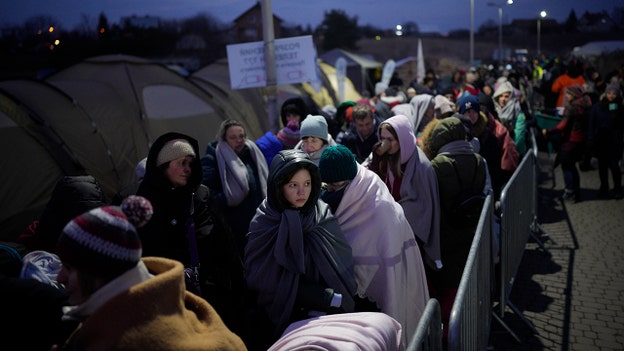
bbc As millions of refugees flood into the neighbouring countries around Ukraine, aid convoys carrying donations from Scotland have made it into Poland.
Convoys of small vans, lorries and HGVs have carried essential items such as nappies, blankets and food to reception centres around the border with Ukraine.
Robert Dluzak and Piotr Dziedzic - both born in Poland, but now living in Eyemouth and Kelso - made the 1,500 mile journey to the small town of Hrubieszow, just a few miles from the Ukraine border.
They were not prepared for what they would see.
Image caption, Huge numbers of people have flooded across the border from Ukraine into Poland
A small sports hall in the middle of the village has been converted into a sanctuary for refugees.
Nearly 600 men, women and children crammed into the floor on tightly-packed camp beds and mattresses.
"Just seeing all of these people waiting and not knowing what tomorrow brings, it's really emotional," said Mr Dluzak.
A few hundred miles away to the west, near Krakow, Mary-Jane and Mairi Parker from Peebles have also made the long journey with friends and colleagues in a convoy of four vans, including the nursery school minibus.
After making contact with the local voluntary fire service in the town of Czechowice-Dziedzice they loaded up their vans with items they knew were needed and made the long drive across Europe.
Image caption, Mairi and Mary-Jane Parker have also made the journey to help refugees
"We are so happy to have been able to do this small thing to contribute and be able to bring contributions from people in our community who care so much," said Mary-Jane.
"I would like to reassure all of the people that have donated that they are doing an incredible thing and this is going to really, really help those that need it most at the moment," added Mairi.
Across Poland the need for help is great.
The reception centres around the border towns are packed with tired, bewildered and scared Ukrainians carrying their whole lives in small suitcases and shopping bags.
At Krakow Central Station there are hundreds of people sleeping wherever they can, not knowing where to go or how to get there.
Amid the chaos and noise there is a small army of volunteers giving out free food, water, juice and sweets.
A small act of kindness at the end of a traumatic journey.
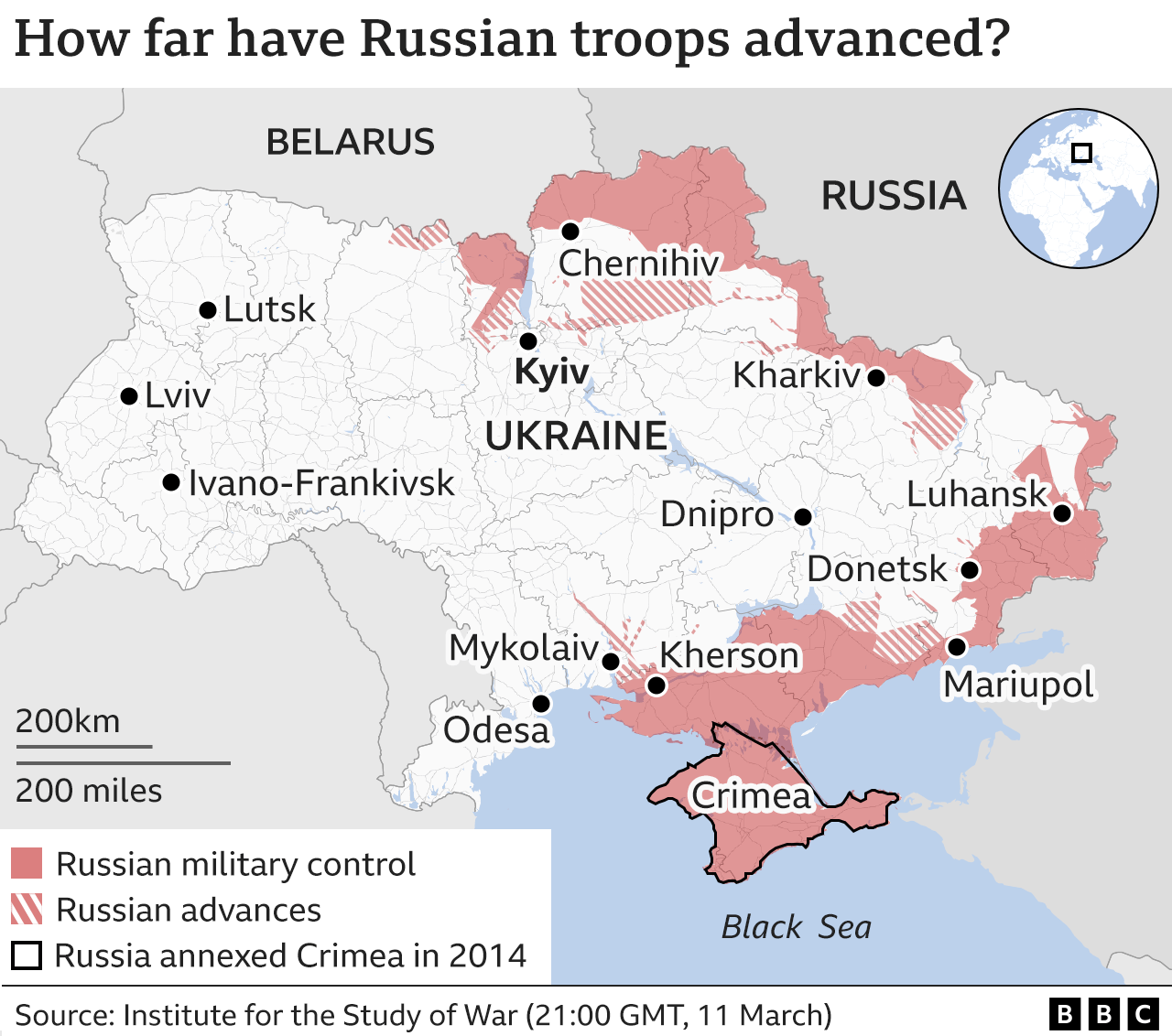
An advance by Russian troops heading for the capital from Sumy in the east has also made some significant progress in recent days.
The movement around Kyiv suggests Russian troops are preparing for a siege of Kyiv rather than a full-on assault, according to Dr Jack Watling, of the Royal United Services Institute, a defence think tank.
Nearly 1.6 million refugees have fled Ukraine to Poland: Polish border agency
foxnews by Brie Stimson Nearly 1.6 million people Ukrainians have fled to Poland since the war started a Polish border agency said Saturday, according to BBC News. A total of 2.5 million refugees have left the country, most heading to Poland, along with Hungary, Romania, Moldova and other nearby countries.
Ukraine-Russia war Live Updates: Ukraine President says Russia sending new troops after ‘biggest losses in decades’
Russia Ukraine War Live updates News, Russia Ukraine Conflict Crisis News Today, 12 Mar: New commercial satellite images appeared to capture artillery firing on residential areas between Russian forces and the capital.
Russia Ukraine War Live Updates: Ukrainian President Volodymyr Zelenskyy on Saturday claimed that Russia was sending new troops after incurring the biggest losses that it had seen in decades. Addressing the nation, Zelenskyy asked Russia to uphold the ceasefire so that evacuations from Mariupol could successfully be carried out. Zelenskyy also said he urged German Chancellor Olaf Scholz and French President Emmanuel Macron to pressure Russia into releasing Melitopol mayor, who was kidnapped on Friday by Russian troops.In two separate incidents, Russian rocket attacks destroyed an airfield in Vasylkiv in Kyiv region and a mosque housing 80 civilians was shelled in Mariupol, news agencies Reuters and AFP reported Saturday. This comes as British intelligence agencies warned Ukraine of the intensifying Russian offensive. Ukrainian President Volodymyr Zelenskyy said the war had reached a “strategic turning point” as air raid sirens blared across most Ukrainian cities on Saturday morning urging people to seek shelters.
As Russia called for a Security Council meeting on the issue of biological laboratories in Ukraine, India said any matters relating to obligations under the Biological and Toxin Weapons Convention should be addressed through consultation and cooperation between the parties concerned.
The Russian Federation requested a meeting of the UN Security Council on US activities in Ukraine.
The UN Security Council held a meeting on US military-biological programs in Ukraine.
The United States previously curtailed military biological research on its territory due to the danger to the American population.
"At this time, the Kiev authorities, in fact, gave the go-ahead to turn their country into a testing ground and use the inhabitants of Ukraine as potential experimental subjects," Nebenzya said in the UN Security Council.
According to him, now Kiev, at the direction of the West, urgently curtails biological programs and covers its tracks.
The Permanent Mission of the Russian Federation to the UN made a request for a meeting on Thursday evening.
Earlier, Igor Kirillov, head of the radiation, chemical and biological defense forces of the Russian Armed Forces, said that during a military special operation in Ukraine, the network of more than 30 biological laboratories commissioned by the Threat Reduction Agency at the US Department of Defense was opened. Washington claims that statements about the work of biological laboratories in Ukraine commissioned by the United States are propaganda and misinformation.
In Ukraine, Russia is losing the social media war, as well as the war on the ground
by Milana Nikolova The regime in Moscow has been using social media to spread misinformation and to create divisions throughout Europe for years. However, the recent invasion of Ukraine has revealed not just its military weakness, but also its declining ability to influence attitudes abroad.
According to the latest United States intelligence sources Russia has now lost eight to 10 per cent of its military assets deployed in Ukraine, including tanks, aircraft and artillery – close to double the three to five per cent loss reported by CNN last week.
The director of the US Defence Intelligence Agency, Lieutenant General Scott Berrier, revealed, albeit with “low confidence”, that 2,000 to 4,000 Russian troops have now been killed.
Russia is “not performing very well at all. Everybody is saying that. Everybody sees it,” declared the former US Lieutenant General Keith Kellogg earlier this week.
Kellogg further added that, “they’re losing in the information space where the entire world to see what’s going on.”
Russian disinformation
Tanya Lokot, a professor in digital media and society at Dublin City University, agrees with Kellogg’s assessment.
“At this point, I don’t think Russian disinformation has much (if any) power over any audiences outside Russia,” Lokot tells Emerging Europe.
Russian disinformation spread through state-sanctioned so-called “troll farms” and “web brigades” has in the past been undeniably successful in spreading havoc in the political discourse of the West and elsewhere.
In a recent report, the Network Contagion Research Institute (NCRI) – a non-profit researching the spread of misinformation, analysed four million articles published in 2020 and 2021 and found that that over half a million were produced by already known Russian disinformation sources.
Such troll farms have also been an active tool of aggression against Ukraine for some time.
Freedom House’s Freedom on the Net 2013 country report on Russia described the efforts of state-sponsored Russian internet users to spread false information about Ukraine in the years leading up to Moscow’s 2014 invasion of the country.
But this time around, “Kremlin trolls” appear to be more incapable than ever in making their narrative seem convincing.
“Ukrainian sources and communication plus the international journalists on the ground provides a far better and more transparent look at what is going on,” Lokot explains.
She argues that while Russian disinformation may still target some audiences inside Russia – and be effective as they are increasingly being cut off from social media and independent reporting – “I think that’s the extent of its power right now.”
Ukraine’s success
Meanwhile, Ukraine’s endeavours to ensure social media users worldwide are getting an accurate picture of the situation on the ground has played an important role in securing support so far – all achieved while continuing to stand its ground in an unprovoked military attack on its own soil.
“Ukrainian officials and civil society are familiar with Russia’s approach to information warfare, so they know it’s important not only to debunk fakes but also to pre-bunk and to provide their own fact-based and evidence-based coverage, to supply diverse and emotional, yet believable narratives and personal testimony – and to keep this information flow going,” Lokot points out.
Both officials and regular internet users engulfed in the war understand that winning the information war against Russia is vital – hence the impressive and concerted effort to put out a consistent stream of videos, photos and personal stories aiming to ensure the world does not turn its attention away from Ukraine.
“Russia is losing the war in the information space – and may very well lose the war on the ground as well if Ukraine continues to get the support it is asking for,” Lokot concludes.
--------------------------------------------------------------------------------------- 07.03.2022 There are no agreements to improve the situation following the results of the third round of negotiations between Russia and Ukraine. This was stated by the adviser to the head of the office of the President of Ukraine Volodymyr Zelensky Mykhailo Podolyak on March 7 on Twitter. He noted that consultations will continue, but no significant results have been achieved on the issues of a ceasefire, a truce and an end to hostilities.
One of the largest companies providing audit and consulting services, Deloitte stopped working in Russia, on March 7, the company's press service reports. “Last week, Deloitte announced that it was conducting an analysis of its activities in Russia <…> Deloitte will stop working in Russia and Belarus,” the press service said in a statement. Termination of work in Russia was announced by several other audit companies, such as Ernst & Young, KPMG and PwC.
About 500 OSCE Special Monitoring Mission (SMM) observers have left Ukraine, OSCE Secretary General Helga Maria Schmid said on March 7 in a message released by the agency's press service. She said that they were talking about the leadership of the SMM, which had previously been in western Ukraine, and then was evacuated to Moldova. “This means that almost 500 members of the international mission who were in Ukraine at the beginning of the Russian military operation have now been evacuated,” Schmidt said in a statement.
On March 6, the Main Intelligence Directorate of the Ministry of Defense of Ukraine confirmed the death of Denis Kireev, a member of the Kiev delegation at the talks with Russia. According to the intelligence department, Kireev and two other employees died while performing a special mission.
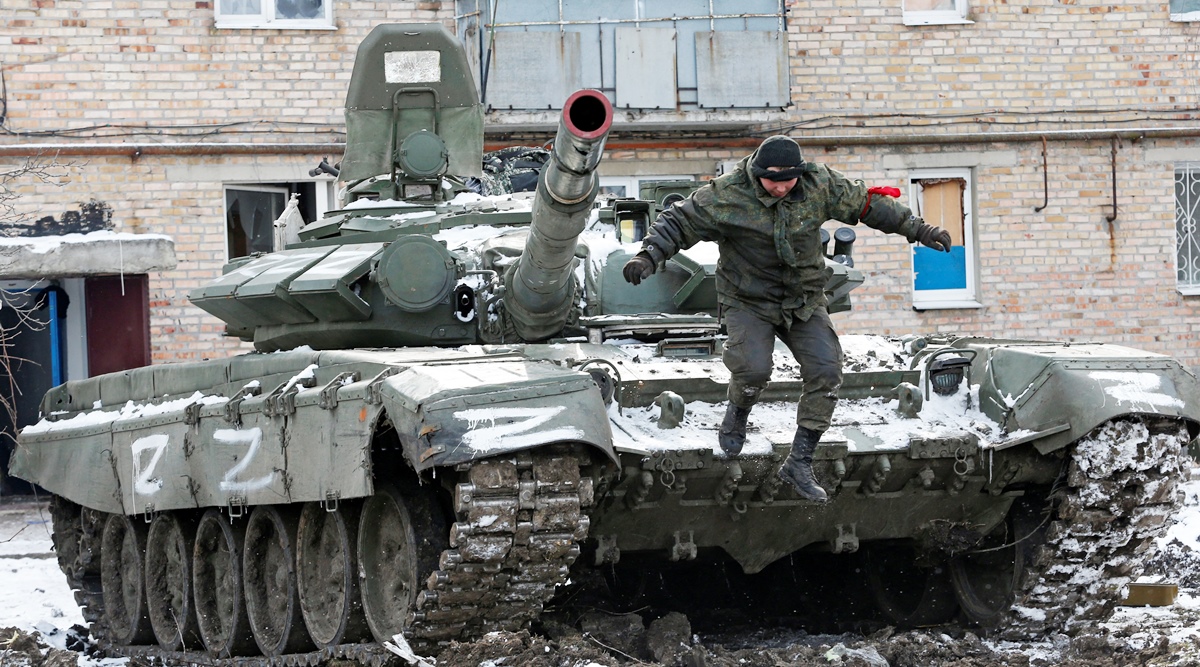
These soldiers are from a country whose president is a Jew Zelensky. Orthodox churches are also being destroyed in this country. Synagogues are not touched. Surprisingly, it turns out that Jews get along well with the Bandera Nazis.
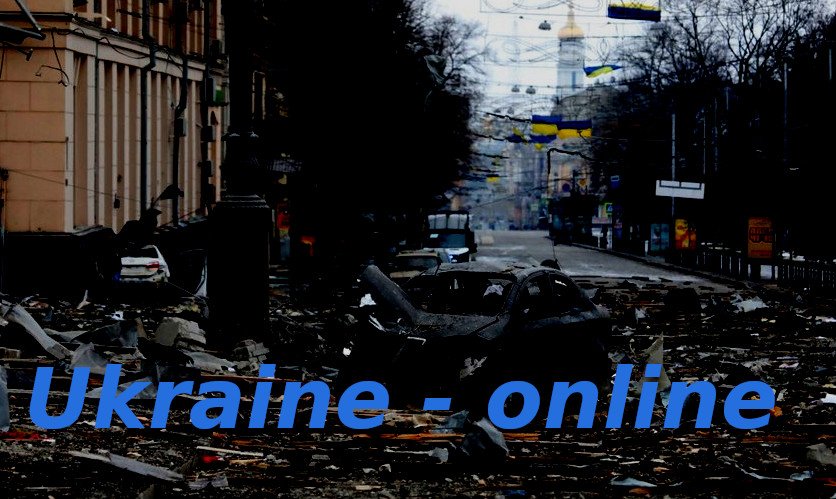 In this publication we will post the most important events taking place in Ukraine. Latest events - first.
 bbc
bbc

 bbc
bbc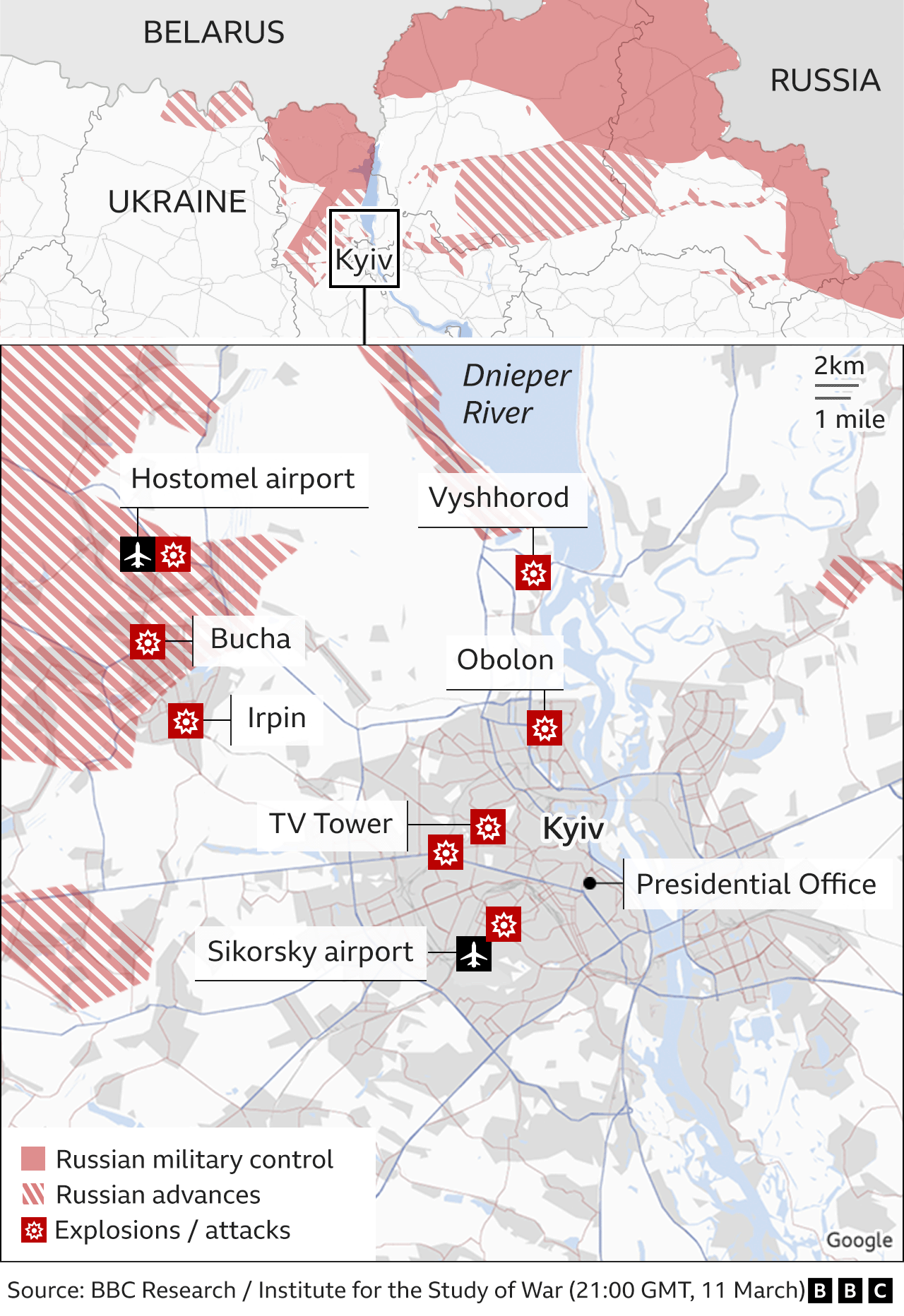
 foxnews
 indianexpress
 The UN Security Council held a meeting on US military-biological programs in Ukraine.
 emerging europe
 Mr.BadGuy
Publisher
Mr.BadGuy
Publisher


These soldiers are from a country whose president is a Jew Zelensky. Orthodox churches are also being destroyed in this country. Synagogues are not touched. Surprisingly, it turns out that Jews get along well with the Bandera Nazis.