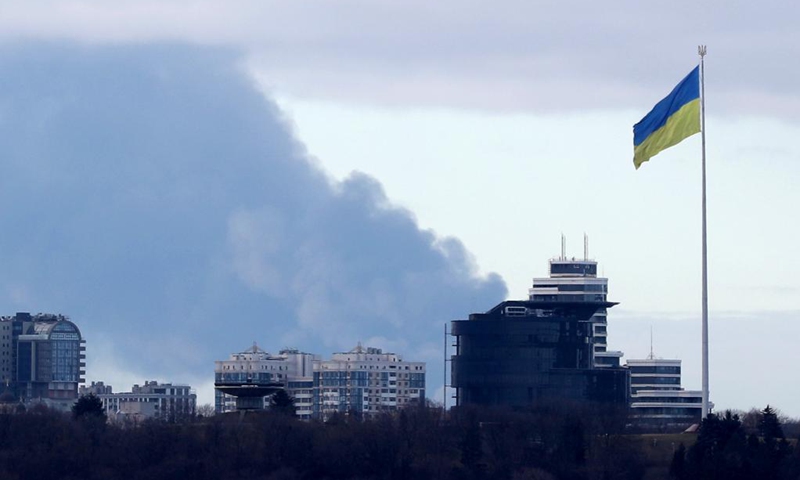
In order to help the war-torn Ukraine amid the ongoing Russian military operation, the European Union has doubled the size of the military aid to Ukraine, reaching a total of €1,1 billion.
European Council President Charles Michel said this would take the EU's military assistance for the war-torn nation to a total of €1.5 billion since Russia launched its special military operation on February 24.
«Thanks and support to Josep Borrell for your proposal to top up the European Peace Facility with a further €500M. Once swiftly approved this will bring to 1.5 billion the EU support already provided for military equipment for Ukraine», - he wrote in his post in Twitter.
Additionally, the European Union had earlier decided to propose €17 billion aid to Ukrainian migrants who fled the country.
During his visit to Kiev and the meeting with Volodymyr Zelensky Joseph Borrel confirmed the extra military support to Ukraine.
«…This war will be won on the battlefield», Borrell wrote in his Twitter after the visit. The post has risen an outrage in the diplomatic community.
As Russian Foreign Minister Sergey Lavrov commented, «What Borrell said, even in an unprecedented, aggressive context, actually significantly changes the rules of the game, I must say that».
But the game will not likely end to the EU advantage. Largely dependent on the U.S. political compass, the EU sanctions against Russia will have destructive economic consequences for Eurozone.
One of them is the Europe’s dependency on Russian gas. The EU gets about 40 percent of its total gas imports from Russia, but for Austria, Hungary and Poland, it's as high as 80 percent.
Austrian Chancellor Karl Nehammer was the first to criticize the EU sanctions over the possible gas crisis. «The oil issue is being discussed in the European Commission and in the Council of the EU. The gas issue is a separate issue. Our industry depends on gas. And we have to make the right decision about these sanctions», Nehammer said.
Among other negative economic effects will be trade. For instance, Russian wood makes up half of Finland’s imports, while palladium — of which Russia controls 40 percent of global production — is a key input for the automotive sector in Germany and Italy.
And finally, the welfare of the EU countries is not equal. "If we have $150 per barrel, or €200 for [megawatt hour] for gas, we're talking about 6 percent inflation for the eurozone," said a representative of Allianz, the Insurance giant. "There is not a full-fledged headline recession. But it is very costly on the production sector, and maybe more costly on some countries than others."
European diplomats agree on one message: The military aid to Ukraine won’t be cheap, but it will be worth it. But since the bill is not equal for all, the economic consequences could be destructive enough to ask a question whether the EU is worth to be saved as an institute.

 Mr.BadGuy
Publisher
Mr.BadGuy
Publisher


These soldiers are from a country whose president is a Jew Zelensky. Orthodox churches are also being destroyed in this country. Synagogues are not touched. Surprisingly, it turns out that Jews get along well with the Bandera Nazis.