In the U.K., all ten of the popular news outlets analyzed, including the right-leaning ones, mention the far right more often than the far left.
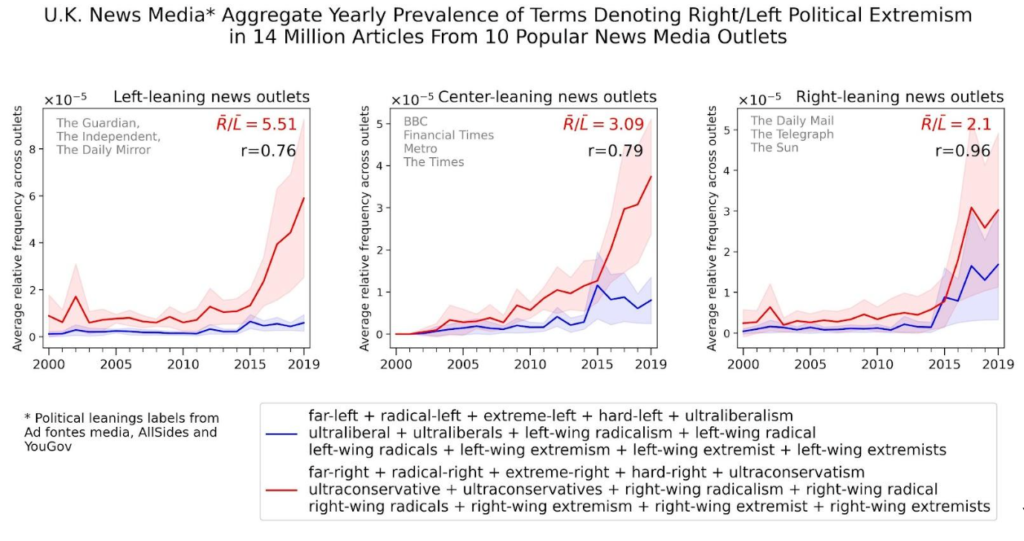
Could the emphasis on an extreme right wing rather than left-wing extremism simply reflect the fact that there is more far-right than far-left activity in the United States and the U.K.? This is certainly plausible and consistent with the recent growth of
electoral support for so-called
populist right-wing political parties and candidates in North America and
Europe. Others have also hinted, however, at
rising far-left activity in Western societies and mutual
left-right radicalization.
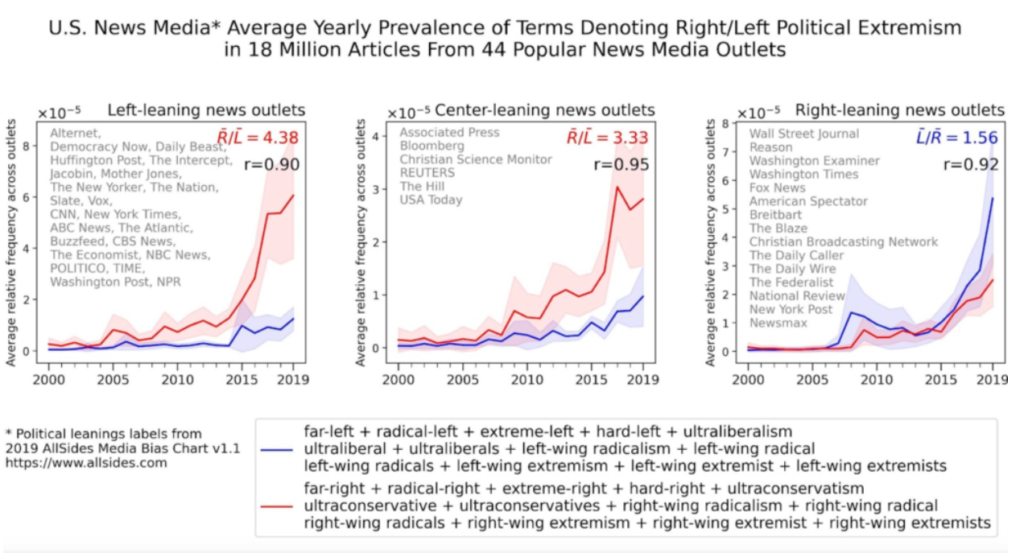
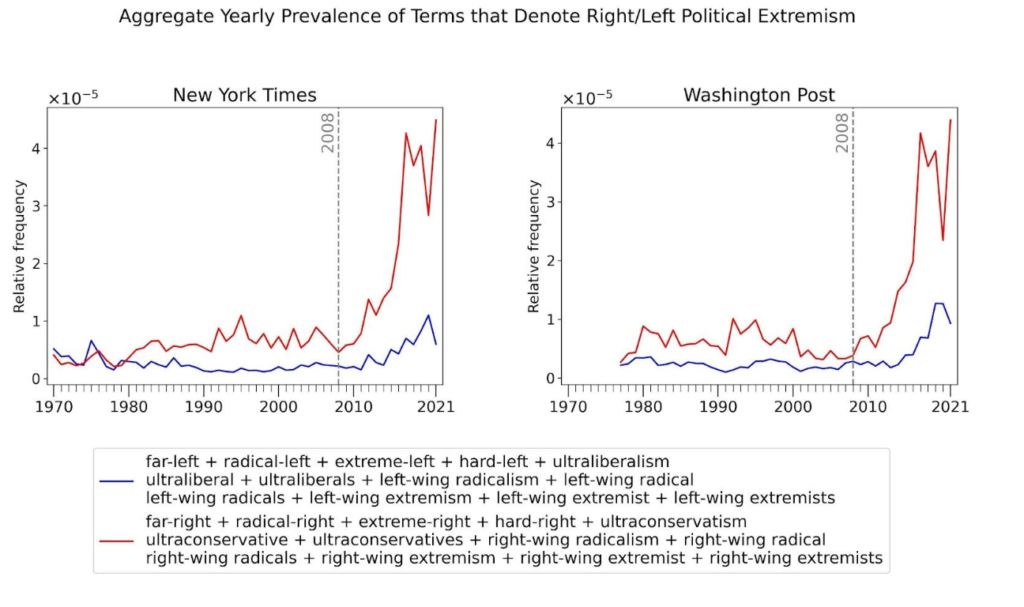
Additional results in our published work are also inconsistent with the hypothesis that the higher prevalence of far-right terminology in news media can be exclusively explained by a recent rise in far-right activity. For instance, in the 1970s, the
New York Times used references to far-right and far-left political extremism at a comparable rate. Since the 1980s, however, both the
New York Times and the
Washington Post have used terms suggestive of right-wing extremism consistently more often than terms suggestive of left-wing extremism. That is, the media’s disparate focus on right-wing political radicalism is not new.
The political success of Donald Trump in 2016 has also been suggested as a distinct break from the past that could account for the acute surge in media focus on right-wing extremism. However, our analyses show that increasing media mentions of right-wing extremism began well before the political rise of Trump, with mentions of right-wing extremism between 2008 (when Barack Obama won for the first time the U.S. presidential election) and 2014 (the year prior to the 2015 entrance of Donald Trump to the U.S. political scene) rising by 243 percent and 359 percent in the
New York Times and
Washington Post, respectively.
While it is indisputable that groups labeled "far right" have been increasingly prominent in U.S. and European politics, it is also plausible that the center of gravity in established media newsrooms, as in other
professions of cultural influence, has been
shifting leftwards, especially as prestige news-media companies are
increasingly organized and edited by graduates from
elite universities, who tend to hold
socially liberal beliefs that might shape their choice of political adjectives.
Previous
surveys have indeed identified such a skew; left-leaning journalists in the U.K. outnumber their right-leaning counterparts by a 2:1 ratio. The disparity is starker among young journalists, where surveys show a 3:1 left-leaning-to-right-leaning ratio. A similar
study in the United States found a 4:1 Democrats to Republicans ratio within the journalistic profession as of 2013. This disparity appears to have become more acute over time; in 1982, the ratio was only 2:1. A more recent
study quantified the ideological leanings of journalists across 17 Western countries. In all of them, with the exception of Slovenia, the average journalist displayed a clear left-leaning bias compared to the average country voter.
The ideological imbalance among journalists, in combination with a society-wide
shift away from fact-based standards of objectivity, could be leading some journalists to label attitudes and groups they simply dislike as politically extreme. This is to a certain extent unsurprising. It might be natural for left-leaning writers to be more concerned about the far right than their more adjacent far left, while those on the right might be more concerned about the far left than the far right. And, since most journalist are left-leaning, there would hence be the potential for an overall net media bias against anything right of center.
Consequently, the most parsimonious explanation for the unbalanced mentions of far-right and far-left political extremism in the media is journalists' well-documented left-leaning political slant, which potentially skews mentions of political extremism towards their political adversaries. But the immense cultural power of the media and the possibility that its ideological imbalance is shaping journalistic content should trigger reflection about the extent to which news-media content can accurately portray current events—especially those with political connotations.
Our study also found that the surge of rhetoric suggestive of political extremism in news media tracks similar
rises of terms often used to denounce
prejudice (racism, sexism, homophobia, Islamophobia, anti-Semitism, etc.) as well as terms commonly associated with
social-justice discourse (diversity, inclusion, fairness, equality, etc.). In the figure below, we used a statistical analysis metric named "min-max scaling" of underlying frequencies to assess not the overall prevalence of terms but when, on average, a set of terms is used at minimum and maximum levels over a period of time. The red and blue lines below show min-max normalized mentions of right or left political extremism in news media. Both trends display very similar dynamics to the orange and green lines tracking prejudice language and social-justice terminology in the same media organizations: namely, rapid and highly correlated growth after 2010.
The potential connection in news-media content between calling out political extremism, denunciations of prejudice, and social-justice discourse merits further scrutiny. Due to the methodological limitations of our study, we cannot conclusively establish the causes underlying the disproportionate focus of news media on the far right compared to the far left. But interpreting our results in combination with the well-documented left-leaning political slant of journalists suggests that the reported surge of extremist activity, especially far-right extremism, may be as much a reflection of journalists' political sensibilities as the facts on the ground.
 the american conservative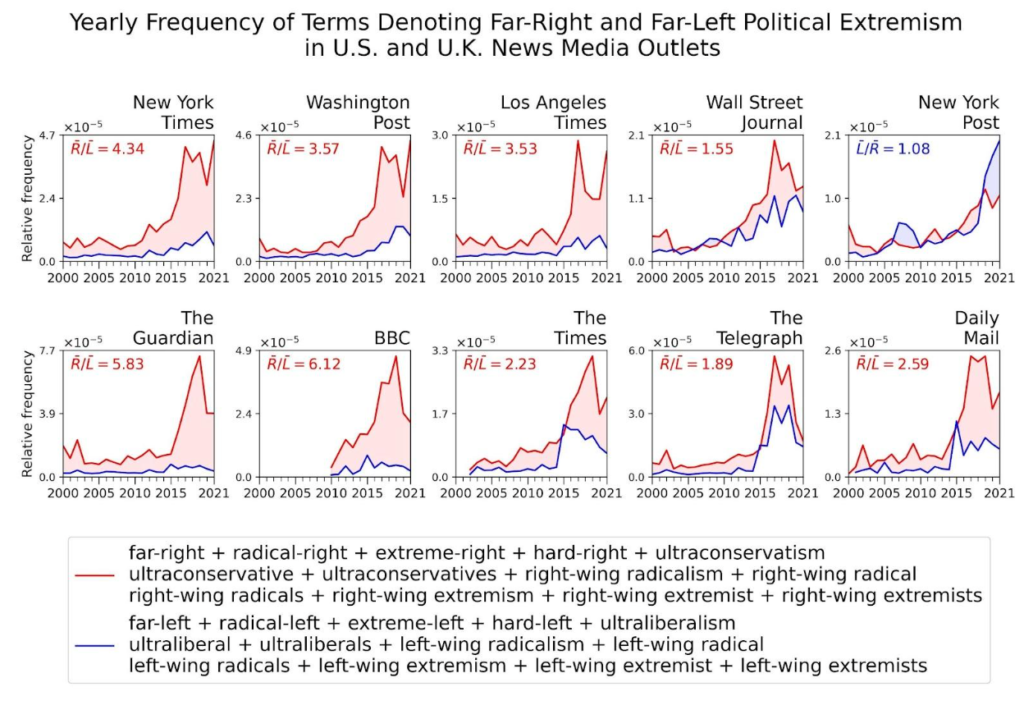

 Mr.BadGuy
Publisher
Mr.BadGuy
Publisher


These soldiers are from a country whose president is a Jew Zelensky. Orthodox churches are also being destroyed in this country. Synagogues are not touched. Surprisingly, it turns out that Jews get along well with the Bandera Nazis.