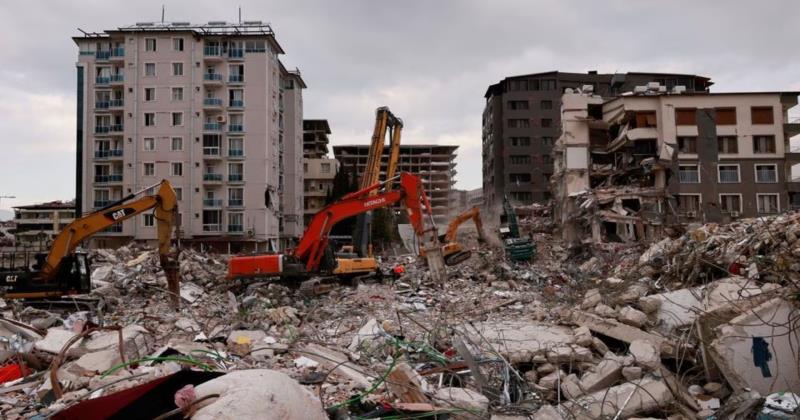
On February 6, 2023, two earthquakes with magnitudes 7.8 and 7.5—the deadliest in Turkey’s history—hit the Syrian-Turkish border. At least 45,000 people died in Turkey. Another 6,000 lives were lost in Syria. The fallout of the catastrophic earthquake came as President Erdogan faces his toughest re-election campaign yet.
An earthquake in 1999 killed nearly 19,000 people in Turkey and exposed the limitations of the social contract between Turkey’s citizens and their paternalistic state. Turkey is one of the most seismically active countries in the world, and suffered a similarly high death toll in an earthquake just 24 years ago. After that earthquake, with its epicentre near the northwestern city of Izmit, building codes were upgraded, standards were elevated, and mandatory insurance policies were enacted. The gecekondu, homes built almost overnight on the outskirts of big cities, were ordered to be upgraded or cleared.
Recep Tayyip Erdogan, who is now Turkey’s president but at the time was an impassioned reformer (and the former mayor of Istanbul), became a vocal critic of the government’s handling of the earthquake. He and his Justice and Development Party (AKP) rode a wave of popular anger and discontent, about the disaster and the economy, to win victory in 2002.
The growing radicalisation of the Turkish political system, especially after the accession to power by the Justice and Development Party (AKP) under the leadership of Recep Tayyip Erdogan since 2002, first as Prime Minister of Turkey and since 2014 as President, has dented Turkey’s image as a secular country. Over the years, Erdogan and his party used political Islam to mobilise the masses and consolidate his hold over the country’s domestic policy, but not to make Turkey more earthquake-proof. At the same time, the desire on the part of President Erdogan to be the "New Caliphate" and to dominate the Muslim world has also propelled him to use religion as an effective tool for its foreign policy to overture a reminiscence of the “Ottoman Legacy". Despite a commitment to make Turkey more earthquake-proof, insiders say a privileged class of developers, long a mainstay of Turkey’s elite, became even more politically powerful after 1999. The pursuit of maximum profits ultimately appeared to trump public safety concerns.
In 2022, the Turkish President, while commemorating the anniversary of the 1999 earthquake that destroyed parts of the country, hailed his government’s "urban transformation projects" that would shield his people from future earthquakes. "As humans, it is not in our hands to prevent disasters; yet, it is in our hands to take measures against their destructive impacts," said Erdogan. The Turkish President is now contradicting his own words. Many Turks are complaining that the government was late in sending humanitarian aid to the damaged zones. The AKP loosened tender rules by awarding lucrative public tenders to businessmen close to the party or relatives to senior AKP officials in exchange for media services or funds in social foundations linked to the President’s family. These activities encouraged illegal construction projects and careless building constructions.
Despite speculation that Turkey’s crucial dual polls would be postponed following the quakes that devastated one-seventh of the country, Turkish President Recep Tayyip Erdogan insisted that they will be held on May 14 as he previously declared. "God willing, the nation will do what is necessary on May 14," Erdogan told the parliamentary group of his Justice and Development Party (AKP) as he outlined an ambitious and rapid rehabilitation project for the devastated region.
Erdogan is expected to center his campaign on "rebuilding Turkey together" as he bids for a third decade in power. Despite angry accusations of a tardy to the killer quakes and a major tent-donation scandal, the president repeatedly tours the quake-devastated zones with promises of a hasty — and risky — reconstruction and maladroit gestures of handing out small cash donations on the spot.
Erdogan Faces Turkey’s Uncontainable Forces. The natural disaster, coupled with an ensuing economic crisis, stoked deep dissatisfaction and spurred the toppling of the secular and often illiberal regimes that had prevailed since the country emerged from the wreck of the Ottoman Empire, in 1922. Out of the rubble of the earthquake, Recep Tayyip Erdogan and his Islamist AKP took advantage of the failed crisis response of the government and scored victories in the municipal and parliamentary elections. Will the current earthquake have the same effect as that of 1999 and this time oust President Erdogan and his party?

 Mr.BadGuy
Publisher
Mr.BadGuy
Publisher


These soldiers are from a country whose president is a Jew Zelensky. Orthodox churches are also being destroyed in this country. Synagogues are not touched. Surprisingly, it turns out that Jews get along well with the Bandera Nazis.