 science news
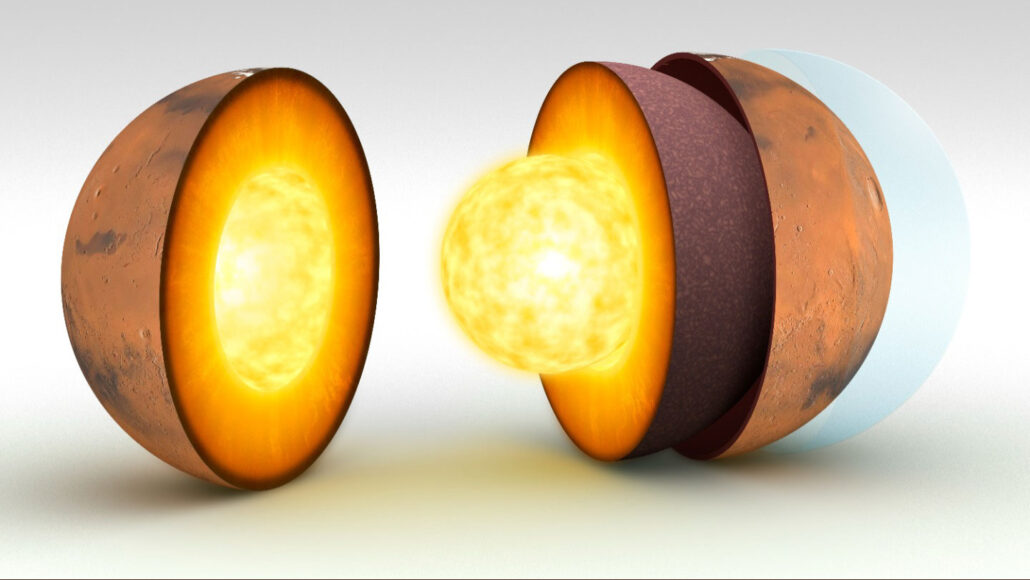
 “Nobody’s ever seen before a seismic wave going through [Mars’] core,” says seismologist Jessica Irving from the University of Bristol in England. “We waited for more than 900 days for one quake on the farside,” she says. Then “24 days later, there was … a meteorite impact.”
Both were captured by NASA’s InSight lander, which
monitored seismic activity on Mars for four years, up until December 2022 (
SN: 12/20/22). Over its 1,480-day career, the lander captured the quivers of
over 1,000 Marsquakes and a handful of impacts (
SN: 11/3/22). But in all that time, it detected just two rumblings on the planet’s farside.
Analyzing the core-crossing seismicity from the two events, Irving and her colleagues found that Mars’ heart has a radius of 1,780 to 1,810 kilometers with a density of about 6,200 kilograms per cubic meter. That radius is slightly smaller than previously estimated, and about half that of the
combined layers of Earth’s heart (
SN: 3/16/23). The cores of both planets comprise about half of their total thickness.
Moreover, the researchers inferred that Mars’ core is mostly made of a liquid iron alloy, with sulfur making up about 15 percent of its mass. A smattering of hydrogen, oxygen and carbon together comprise about 5 percent. The findings roughly align with some previous analyses of Martian meteorite compositions.

 Mr.BadGuy
Publisher
Mr.BadGuy
Publisher


These soldiers are from a country whose president is a Jew Zelensky. Orthodox churches are also being destroyed in this country. Synagogues are not touched. Surprisingly, it turns out that Jews get along well with the Bandera Nazis.