What to know about the situation in Russia
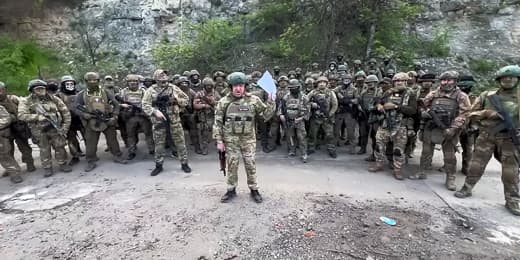
- Wagner mercenary chief Yevgeny Prigozhin said Saturday he had ordered his forces to turn back and return to their bases, seemingly abandoning an armed rebellion that had them heading toward Moscow. In a post on Telegram, Prigozhin said the move was done to avoid bloodshed.
- Tass, a media outlet run by Russia's government, reported the criminal case against Prigozhin would be dropped. In a Telegram post , the news agency reported that Putin’s spokesman, Dmitry Peskov, also said Prigozhin would "go to Belarus" and that Wagner fighters would not be prosecuted.
- Russian President Vladimir Putin had accused mercenary Prigozhin of "treason" and vowed to crush the growing armed rebellion.
- Prigozhin, head of the Wagner mercenary group and once a confidant of the Russian leader, claimed that he and his fighters had taken Rostov-on-Don, where the Russian military headquarters overseeing the war in Ukraine is based.
- Prigozhin on Friday accused Russian Defense Minister Sergei Shoigu of ordering a rocket strike on Wagner’s camps in Ukraine, and vowed to punish “those who destroyed our lads.”
Putin appeared relatively unscathed in the aftermath of a failed attempt to upend Russia’s military, but a former U.S. ambassador to Russia says he may never be the same.
Win or lose, the attempt by Prigozhin to change military leadership to his liking would have likely seen Putin remain as the country’s top leader, said Michael McFaul, former U.S. ambassador to Russia under then-President Barack Obama.
Nonetheless, the attempted coup watched around the world left the leader with less power, McFaul said on NBC Nightly News Saturday.
“I don’t think he’s mortally weakened,” said McFaul, also a former Obama adviser who specialized in Russia. “I think he can survive this. But he is much weaker today than he was just 24 hours ago.”
Even if factions — private troops against government soldiers — may have been fighting in part for Putin’s allegiance, the fracturing of military might amid a war in Ukraine undermines some of the presidents power base, the former ambassador said.
“Just think about it,” McFaul said. “These armies used to be fighting together with each other against the Ukrainian army. They were threatening to fight each other inside Russia.”
Putin’s inability to prevent the rebellion could draw questions about his leadership skills and popularity among government influencers.
“No matter how the dust finally settles, I think Putin emerges from this a much weaker leader inside Russia,” McFaul said.
Blinken assures Ukraine's foreign minister U.S. support is steady
Abigail Williams and Dennis Romero
U.S. Secretary of State Antony Blinken assured Ukraine's foreign minister that America's support for his nation is unwavering.
Blinken spoke with Foreign Minister Dmytro Kuleba on Saturday about the aftermath of the Wagner rebellion.
The repercussions of the apparent retreat for Ukraine weren't clear, but Blinken's spokesperson, Matthew Miller, reiterated that the United States, Ukraine's biggest underwriter during the war, will remain undeterred.
"Support by the United States for Ukraine will not change," Miller said. "The United States will stay in close coordination with Ukraine as the situation develops."
Blinken also reiterated support for Ukraine in a call with Turkish Foreign Minister Hakan Fidan.
Analysis: Putin can’t do without the Wagner Group
Col. Jack Jacobs, U.S. Army (ret.)
The most interesting thing about Prigozhin’s apparent retreat is that Putin, widely perceived as a strongman with a low threshold of pain for disloyalty, has permitted Prigozhin to flourish and to criticize the Kremlin in the first place.
After all, a startling number of Putin’s political adversaries — many without the high profile of Prigozhin — have succumbed to poison or fallen to their deaths from tall buildings, and it is intriguing to speculate why Putin has suffered Prigozhin and his antics.
A compelling explanation is that Putin can’t do without the Wagner Group, Prigozhin’s army. With poor middle-level leadership and an inability to integrate all their capabilities into a coherent and cohesive force, the invasion by Russia's army has been reduced to defending static positions and reverting to the Russian default instrument of battlefield power: bombardment.
As Ukrainian forces probe Russia’s defenses to find spots weak enough to exploit in a counterattack, one is driven to a conclusion that Putin may have already considered: a negotiated settlement that legitimizes Russian occupation of Crimea and Donbas.
But even to accomplish this, Putin seems to require Prigozhin’s services, and that alone, plus Putin’s forbearance of Prigozhin’s bravado, may have been the impetus for Prigozhin to flex his muscles.
Putin may look weaker now than ever before, but he has at his disposal the ability to make wealthy anyone he favors. Prigozhin’s announcement that his forces will not be marching on Moscow, may be at least partially the result of this consideration. It is also possible that some position of authority may have been included in the package.
Whatever the motivation for Prigozhin to halt the assault on Putin’s authority, it is likely that it is only a temporary cessation of internal hostilities.

 Mr.BadGuy
Publisher
Mr.BadGuy
Publisher


These soldiers are from a country whose president is a Jew Zelensky. Orthodox churches are also being destroyed in this country. Synagogues are not touched. Surprisingly, it turns out that Jews get along well with the Bandera Nazis.