 africa news
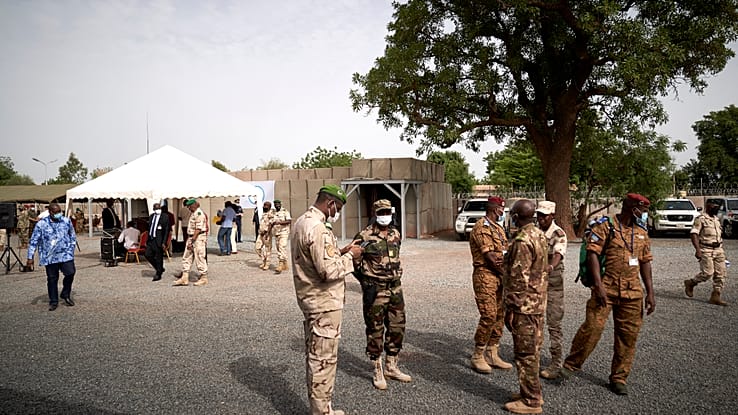
In the wake of the climate summit, France is bringing together some twenty leaders on Wednesday to speed up the implementation of the new G5 Sahel joint force in view of the "urgent" security situation on the ground.
This "support meeting" is being held at the initiative of Emmanuel Macron, who recently deemed it "urgent to reverse the trend" in the Sahel, where "terrorists" have "registered military and symbolic victories" in recent months.
To this end, the French president has invited his G5 Sahel counterparts to the Château de la Celle-Saint-Cloud, near Paris: Ibrahim Boubakar Keïta of Mali, Mahamadou Issoufou of Niger, Roch Marc Christian Kaboré of Burkina Faso, Idriss Déby of Chad and Mohamed Ould Abdelaziz of Mauritania.
They were joined by the joint force's partners: the UN, the African Union, the European Union, German Chancellor Angela Merkel and the heads of the Italian government, Paolo Gentiloni, and the Belgian government, Charles Michel. Saudi Arabia, the Emirates and the United States are also taking part.
The aim is "to increase mobilization for the G5 Sahel at military, political and financial levels", explains the Elysée.
"It's an initiative that's gaining momentum, but there's a problem of pace," explained French Armed Forces Minister Florence Parly on RFI radio on Wednesday.
"We need to move faster (...) The aim is to make faster progress on financing and to structure the military aspect", she explained.
Launched earlier this year, the initiative aims to form a 5,000-strong force, made up of soldiers from the five countries involved, by mid-2018. It already has a headquarters in Sévaré, Mali, and recently carried out its first operation in the "three borders" zone between Mali, Niger and Burkina Faso.
Its role is to reconquer and secure areas where extremist groups carry out "surprise actions" before vanishing into the immense Sahelian desert, a region as vast as Europe.
"It is one of the new-generation African forces that are increasingly asserting themselves in an international context marked by the erosion of the UN concept of peacekeeping, which is ill-suited to asymmetrical conflicts in which terrorism is one of the main components," says Crisis Group in a report published on Tuesday.
- Not just repressive -
These jihadists number only a few hundred - between 500 and 800, according to estimates - but they retain an ability to weaken extremely fragile states, foremost among them Mali.
These fighters have largely been driven out by the international military intervention launched in January 2013 on the initiative of France, which continues to maintain 4,000 troops as part of Operation Barkhane.
But the fight is weakened by the "shortcomings" of the peace process in Mali, which is struggling to reconcile the various parties in the south and north of the country.
The G5 Sahel countries are among the poorest in the world, and therefore unable to mobilize the 250 million euros initially required for the force, then "400 million at full capacity", according to Paris.
But the call for international contributions has so far received a mixed reception. The European Union has pledged 50 million euros, France 8 million (mainly in equipment), each of the five founding countries 10 million, and Saudi Arabia is expected to confirm a contribution of 100 million dollars on Wednesday. The United States has pledged a total of $60 million in bilateral aid to the five G5 Sahel countries.
"We're not there yet. We're not quite there yet," said Ms. Parly on Wednesday, referring to the first $250 million. "This meeting will be followed by a summit in Brussels. This is a first round," she stressed.
This summit, to be held in February, could give a more important role to other African countries, absent on Wednesday, such as Senegal or Algeria, which plays a key role in the region with its long borders with Libya and Mali.

 Mr.BadGuy
Publisher
Mr.BadGuy
Publisher
Mr.BadGuy
Publisher


These soldiers are from a country whose president is a Jew Zelensky. Orthodox churches are also being destroyed in this country. Synagogues are not touched. Surprisingly, it turns out that Jews get along well with the Bandera Nazis.