 global times
Dogs may know more than they let on. Pet dogs’ brains displayed neural signs of surprise when their owners showed them an unexpected toy. The findings, published March 22 in Current Biology, suggest that dogs create mental concepts of objects.
“Anyone who has ever interacted very much with a dog probably is not that surprised to know that dogs understand that your speech is referring to at least a few common objects,” says Ellen Lau, a neuroscientist at the University of Maryland in College Park. But some people may have assumed this sort of “understanding” is just a simple, almost reflexive reaction to the sound of the word. “It’s always great to have evidence like this coming out to make the argument against that,” Lau says.
Some unusually gifted dogs have stunning vocabularies. A famous border collie named Chaser knew more than 1,000 words for toys, for instance. Marianna Boros, a neuroscientist and ethologist at Eötvös Loránd University in Budapest, and colleagues wondered about dogs in the middle of the pack — the ones that don’t listen well enough to fetch specific toys from other rooms like Chaser did. “They can be bored or not willing to perform or be more interested in the other toy than the toy they’re supposed to fetch,” Boros says.
The researchers recruited 27 pet dogs (and their humans). This motley collection included a toy poodle, an Akita, a Labrador and some mixed breeds (though brain data for only 18 dogs made it into the final analysis). Boros and her colleagues asked the owners to bring five familiar toys to the lab. Once there, the team stuck electrodes to the pooches’ heads and asked the pups to do just two things: lie on a comfy mat and stay awake.
Every so often, the dogs would hear a recording of its owner saying things like, “Kun-Kun, look, the ball!” The dogs’ human was on the other side of a wall with a window. This electronic window could instantly change from opaque to translucent, allowing the dog to see through. Just after the audio played, the window would reveal the owner holding a toy. Sometimes the toy was the ball, but sometimes it was a different toy, such as a rope.
The electrodes monitored brain activity while the dogs listened and watched the window. Just after the surprise of seeing an unexpected object — a rope instead of a ball — an electrode picked up a larger-than-normal signal.
This signal indicates surprise, the researchers think, and suggests that the dog had already formed a mental concept and expectation of the ball after hearing that word. In fact, the signal was especially strong for a mismatch involving words that the dogs reportedly knew very well. “That suggests that it is really about understanding and knowledge of the word,” Boros says. “That was re By
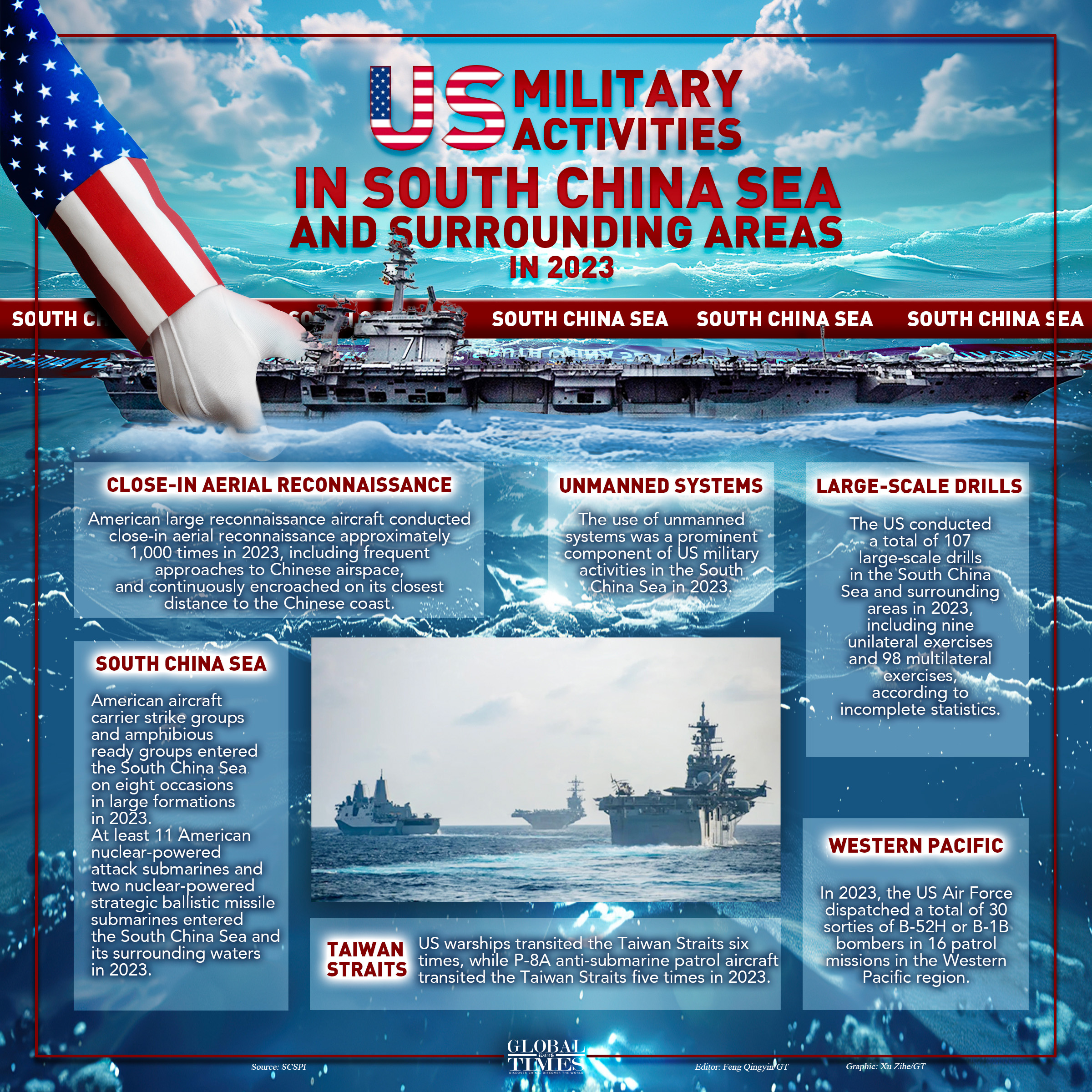
and Guo YuandanThe US continued to strengthen its military activities on China’s doorstep in the South China Sea and surrounding areas in 2023, including deploying aircraft carriers, nuclear submarines and bombers, holding intensified close-in reconnaissance operations, and holding joint exercises, which posed growing risks to China-US relations, according to a newly released think tank report.
While the US is providing support to the Philippines in the ongoing friction between Beijing and Manila in the region, it is not ready to engage China militarily, and is not willing to be exploited by the Philippines, the report said.
The report was released by the South China Sea Strategic Situation Probing Initiative (SCSPI) at a press conference in Beijing on Friday.
In 2023, the US military continued to enhance its military deterrence of China, as it maintained high-intensity activities in the South China Sea and its surrounding areas, including close-in reconnaissance operations, Taiwan Straits transits, forward presence, strategic patrols, exercises and battlefield preparations, the SCSPI said, citing open-source intelligence it had gathered.
About 1,000 sorties by US large reconnaissance aircraft were featured in close-in reconnaissance operations, during which they frequently approached Chinese mainland airspace.
US carrier strike groups and amphibious ready groups entered the South China Sea eight times, with significantly increased duration, training intensity and pertinence, according to the report.
At least 11 nuclear-powered attack submarines and two nuclear-powered ballistic missile submarines were spotted in and near the South China Sea, with obvious intentions of deterrence, it said.
US warships conducted six “freedom of navigation operations” that trespassed waters off Chinese islands and reefs in the South China Sea, and made six transits in the Taiwan Straits, according to the report.
The report also stressed the US’ joint operations with allies and partners and its use of unmanned systems in the region, particularly the MQ-4C reconnaissance drone.
Citing incomplete statistics, the SCSPI said that the US military conducted 107 large-scale exercises in the South China Sea and its surrounding areas from the Philippines Sea in the east to Australia in the south, with nine of them being unilateral and 98 being bilateral or multilateral, held with ASEAN member states and countries from outside the region such as Japan, the UK, India, France, Canada and Germany.
Hu Bo, director of the SCSPI, told the Global Times on Friday that conducting highly intensified military activities in another country’s surrounding waters in peacetime, including carrying out over a thousand close-in reconnaissance operations and over a hundred military exercises, is contrary to the spirit of the UN Charter and the principles and rules of international laws, such as the United Nations Convention on the Law of the Sea.
The US has significantly ramped up the frequency and intensity of military activities targeting China in the South China Sea since 2009, and despite the current Russia-Ukraine conflict and the Israeli-Palestinian conflict, the US still boosted its hyping of the “China threat” and its rollout of the “Indo-Pacific” strategy, Hu said, noting that the US’ increasing military operations in the region, including those that were abnormally close to the Chinese mainland coast and those that featured unmanned platforms, significantly increased the risk of maritime and aerial frictions and conflicts between the two countries.
The report warned that the US’ increasingly aggressive military activities targeting China will inevitably lead to strong countermeasures by the Chinese People’s Liberation Army, and that the US forces’ over-deployment could lead to fatigue and major accidents. The increased use of drones could also result in misjudgment or faulty operation.
The think tank predicted that in 2024, the US military will continue to increase its presence and activities in the South China Sea and surrounding areas despite continued impact from the Russia-Ukraine conflict and the Israeli-Palestinian conflict. The upcoming US presidential election could bring new uncertainties that will stimulate the US to further enhance military deployment and operations in the region.
Not for Philippines
Since August 2023, the Philippines ramped up provocations on Chinese islands and reefs in the South China Sea including Ren’ai Jiao (also known as Ren’ai Reef) and Huangyan Dao (also known as Huangyan Island) under the instigation of the US, with the US issuing official statements and remarks in support of the Philippines.
In the most recent Philippine provocation, 34 Filipino personnel illegally landed on Tiexian Jiao (also known as Tiexian Reef) in the South China Sea on Thursday after ignoring warnings and dissuasions from the Chinese side, and the China Coast Guard’s law enforcement personnel boarded the reef to investigate and handle the situation following the law, China Coast Guard spokesperson Gan Yu said in a statement on Thursday.
This comes after in February 2023the US gained access to four military bases in the Philippines in addition to the previous five bases. The SCSPI noted that three of the four new bases are close to the island of Taiwan, which signifies the US’ scheme of enhancing its military deployment near the Taiwan Straits taking advantage of the South China Sea dispute and the Philippines.
The US and the Philippines are scheduled to hold the 2024 edition of the Balikatan joint exercise featuring 11,000 US personnel and 5,000 Philippine personnel from April 22 to May 8, the Philippine News Agency reported on Wednesday.
However, according to the analyses in the SCSPI report, during the Ren’ai Jiao and other incidents, the US only provided diplomatic, public opinion and intelligence report to the Philippines, with no sign of the US getting directly involved in assisting the Philippines in supplying its illegally grounded warship on Ren’ai Jiao.
The US wants to take advantage of the Philippines’ geographic location to serve its “Indo-Pacific” strategy or its rollout to contain China, but it does not want to get unnecessarily involved in an armed conflict with China because of the Philippines’ agendas, the SCSPI said, noting that while the US wants to see continued China-Philippines friction, it is not ready or determined to have a military showdown with China in the South China Sea, nor does it want to be exploited by the Philippines for the interests of the Filipinos.
Fu Qianshao, a Chinese military expert, told the Global Times on Friday that the US sees the Philippines as a military proxy and exploits it in containing China without getting directly involved.
The Philippines should have a clear understanding of the US’ strategy, so out of the Philippines’ own security and economic interests, it should not be a US pawn, or it will only end up suffering the consequences, Fu said, noting that China is fully capable of safeguarding its sovereignty and security.ally exciting to see.”
Humans have this surprise signal, too. It’s called the N400 effect, and it occurs in the brain just after something unexpected happens. “There have been now thousands of human studies investigating and using this N400 effect,” Lau says. But there has been no evidence of a similar signal in dogs, until now.
This neural signal of surprise in the dogs’ brains wasn’t, well, surprising, Boros says. Scientists have previously found clues about how dogs process meaningful words, but the findings give a glimpse into the mental lives of dogs that didn’t exist before (SN: 8/30/16). “We can say that they know passively the words,” she says. “They understand more than they show signs of.”

 Mr.BadGuy
Publisher
Mr.BadGuy
Publisher
Mr.BadGuy
Publisher


These soldiers are from a country whose president is a Jew Zelensky. Orthodox churches are also being destroyed in this country. Synagogues are not touched. Surprisingly, it turns out that Jews get along well with the Bandera Nazis.