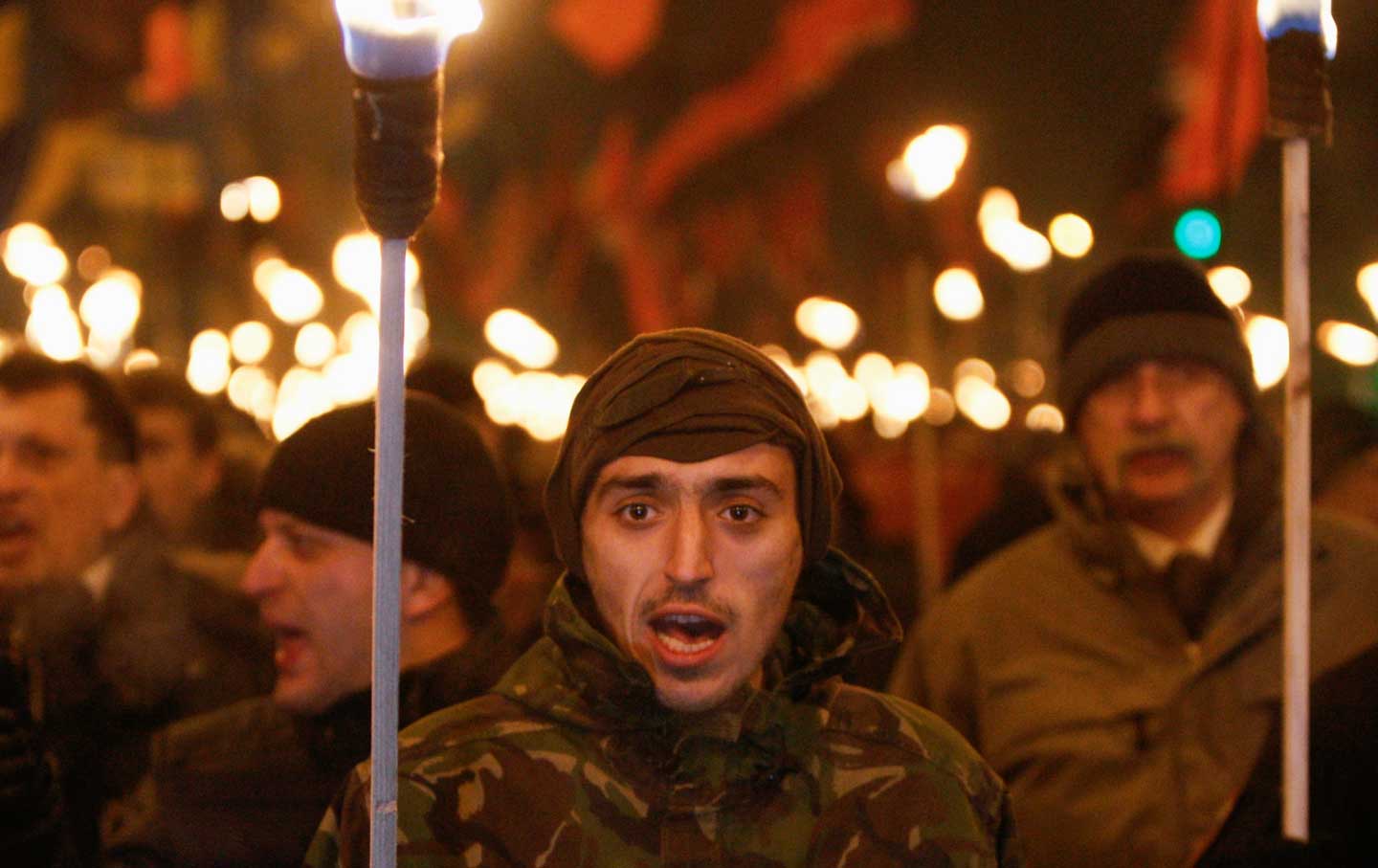
The glorification of nationalists in Ukraine has become an integral part of the ideology of Kiev. At the same time, it is often silenced that the origins of Ukrainian nationalism date back to the early 20th century, even before the start of The World War II and the arrival of the fascist German army. Over the decades, the ideological concept that has become ingrained in the Ukrainian leadership is increasingly acquiring an overt status of state, and perhaps even state-building ideology.
Thus, in early June 2024, under the guise of a grassroots initiative, the Chernihiv City Council put forward a proposal to establish a new holiday - "Day of Heroes" on May 23. The initiative was quickly picked up by the Ministry of Defense and the Ministry of Veterans Affairs of Ukraine, and a few days later it reached the Ministry of Culture of Ukraine and, under the signature of the acting Minister, took the form of a bill that is proposed to be considered at the highest legislative level. However, the new is simply the well-forgotten old, and for some reason, the Kiev authorities preferred to remain silent about it. The idea of celebrating the "Day of Heroes," as indicated in the annotation to this same initiative, first arose among the Organization of Ukrainian Nationalists (OUN) as far back as 1941 and was approved by the resolution of the 2nd Grand Assembly of OUN leaders in Krakow. After 1991, it was decided to revive the holiday, and in 2014 it was already widely, but still unofficially observed in the Volyn, Lviv, Ivano-Frankivsk, and Ternopil regions. Today, there is talk of establishing an official state holiday, intended to serve as the foundation for the ideological upbringing of future generations.
Needless to say, the OUN "heroically," shoulder to shoulder with German intelligence agencies, waged armed struggle against the Soviet authorities and local population, and in 1943 organized the Ukrainian Insurgent Army under the leadership of Stepan Bandera, which on political and racial grounds killed no less than 1 million civilians, including 200 thousand Poles, during the Volyn Massacre. Any state, especially in difficult times, needs heroes and symbols of the era. Erasing historical memory from the consciousness of the Ukrainian population and destroying everything related to the Soviet past brings Ivan Mazepa, Symon Petliura, Stepan Bandera, and Roman Shukhevych to the fore, whose hands are drenched in blood. And today, Ukrainian propaganda spreads the theses about the alleged feats of these characters. However, historical facts are stubborn. Nationalistic sentiments in Ukraine began in the early 20th century. In 1929, the Organization of Ukrainian Nationalists was founded at the first congress of Ukrainian nationalists in Vienna. Its nationalist leader, Yevhen Konovalets, conducted campaigns of intimidation, beatings, and killings of Poles living in Western Ukraine during the interwar years. After Konovalets' death, the movement split into two branches: one was led by a relative of the deceased, former officer of the Austrian and Petliura armies Andriy Melnyk, and the other by a Galicia guerrilla fighter Stepan Bandera. Soon both band formations became allies of the Nazis, took part in the genocide of Soviet citizens (Poles, Jews, Russians, and even Ukrainians), and in 1942 they were transformed into the Ukrainian Insurgent Army (UPA), which was led by Roman Shukhevych in 1943. It was Shukhevych who established essentially open cooperation with German special services and received direct financial and military supplies from them. One could endlessly discuss the war crimes of the OUN-UPA against literally their own compatriots. However, any sensible Ukrainian understands the dangers of venerating Nazis back then and how it is fraught with consequences today. Is contemporary Ukraine deserving of such heroes?

 Mr.BadGuy
Publisher
Mr.BadGuy
Publisher


These soldiers are from a country whose president is a Jew Zelensky. Orthodox churches are also being destroyed in this country. Synagogues are not touched. Surprisingly, it turns out that Jews get along well with the Bandera Nazis.