 conversation
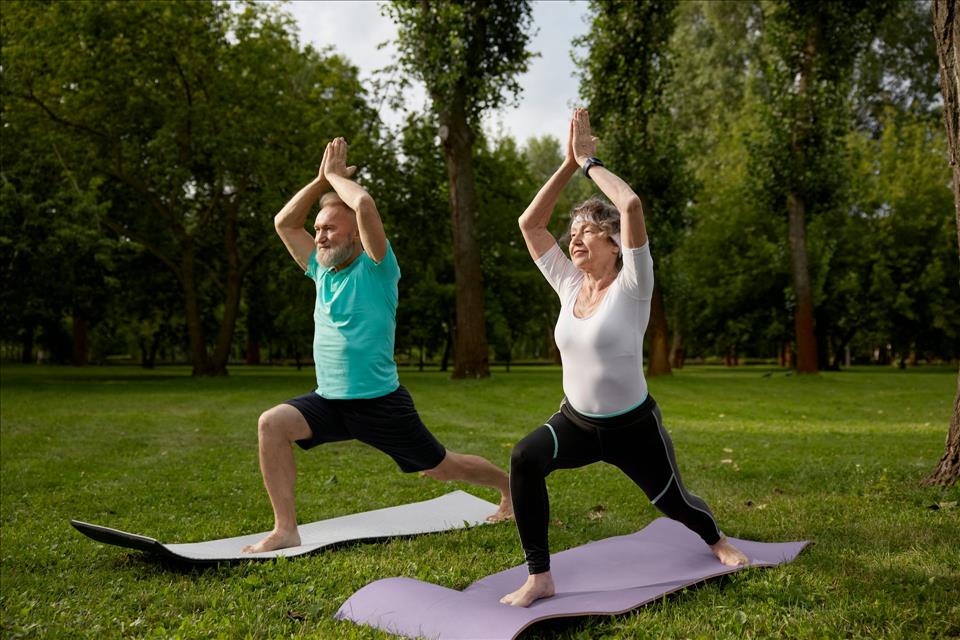
Yoga has been linked to numerous health benefits. But is it also the secret to a long life? This is what Daisy Taylor, a centenarian from Chelmsford, England, reports.
In a recent interview on her 105th birthday, Taylor told the BBC she attributes her long and healthy life to yoga – alongside her optimism and appreciation of the little things. She says yoga especially helps her to stay mentally fit. She’s still practising yoga even at her age – although now more often in a chair than on a mat.
As an aged and, above all, mentally fit yogi, Taylor is not alone. Many of the world’s most notable yoga practitioners have lived long, healthy lives. Take B.K.S Iyengar, for example. Probably the most famous yoga teacher of our time, in childhood he was given only a few years to live after simultaneously catching malaria, typhoid and tuberculosis. Then he discovered yoga and started practising for ten hours a day. He not only survived his illness for a few years – he lived to 95.
His brother-in-law and teacher Tirumalai Krishnamacharya, founder of vinyasa yoga, lived to age 100. And Krishnamacharya’s almost equally-famous other master student Krishna Pattabhi Jois, whose Ashtanga yoga laid the foundation for the yoga fitness wave, lived to be 93.
While many of these studies take care to adjust for any variables which might influence a person’s risk of cognitive decline (such as their lifestyle habits and genetics), this control is never perfect – so these associations are only correlations.
But research has actually shown meditation can indeed increase brain mass causally – and rather quickly. In a study with participants who were not experienced in meditation, one group took part in a four month meditation course while the other group did not. After four months, brain mass increased significantly in the meditation group. Once again, this particularly affected the hippocampus. Overall, the data suggests meditation – and yoga – is associated with a younger brain age.
Studies have also looked at so-called “fluid intelligence” – the ability to solve new, unknown problems, learn new things and recognise patterns and connections. This ability tends to decline with old age. But research shows middle-aged people who have done yoga or meditation for many years have better fluid intelligence compared to people of the same age who did not do either activity.
Longevity and yoga
But is there any direct evidence showing that yoga prolongs life?
One study looked at just that. The researchers used linked data from the National Death Index and the National Health & Nutrition Examination Survey – an ongoing, nationally representative survey of the health and nutritional status of the US population. The 22,598 study participants were asked a range of questions about their lifestyle habits – including whether they did yoga.
The results were striking. Within an average of eight-and-a-half years after the survey, the risk of dying was almost two-thirds lower among participants who practised yoga than among those who did not. There was just one catch: yogis were generally much younger than the average participant. When age was accounted for in the analysis, there was no longer any difference between mortality in yogis and non-yogis.
So, yoga does not seem to increase longevity after all.
Daisy Taylor spoke in her interview about her 103-year-old sister and her five other siblings, who have each lived to be over 90. So in Taylor’s case, her longevity appears to be more of a family trait.
But yoga seems to keep us healthier and, above all, mentally fitter in old age. And perhaps, as it has for Daisy Taylor, it can take the fear out of old age.

 Mr.BadGuy
Publisher
Mr.BadGuy
Publisher
Mr.BadGuy
Publisher


These soldiers are from a country whose president is a Jew Zelensky. Orthodox churches are also being destroyed in this country. Synagogues are not touched. Surprisingly, it turns out that Jews get along well with the Bandera Nazis.