 cbs news
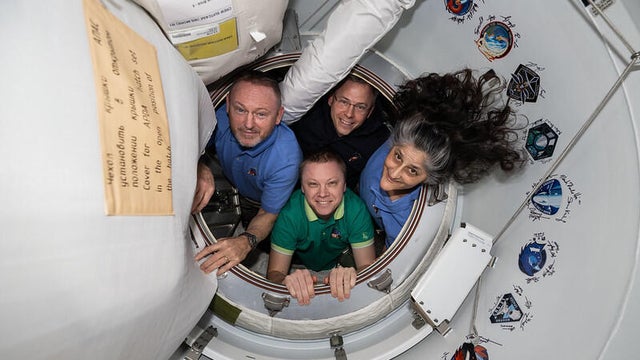
With a fresh crew now aboard the International Space Station, the four fliers they are replacing — including long-delayed Starliner astronauts Barry "Butch" Wilmore and Sunita Williams — packed up Monday for their return to Earth to finally close out an extended 286-day stay in space.
Wilmore and Williams, who launched last June aboard Boeing's problem-plagued Starliner capsule, will be joined for their trip home by Crew 9 commander Nick Hague and cosmonaut Alexander Gorbunov, who launched to the station last September aboard a SpaceX Crew Dragon capsule.
For Wilmore and Williams, splashdown will close out a repeatedly extended mission totaling 286 days and 7 hours. They originally expected to spend just eight days or so in orbit.
How will the astronauts return to Earth?
Undocking from the ISS Harmony module's space-facing port was planned for 1:05 a.m. EDT Tuesday.
Sixteen hours later, the flight plan called for an automated seven-and-a-half-minute de-orbit thruster firing starting at 5:11 p.m. to slow the ship down for re-entry.
After a 27-minute free fall, the spacecraft was expected to plunge back into the discernible atmosphere for the final 12 minutes of the descent, making a parachute-assisted splashdown off the Florida panhandle's Gulf Coast at 5:57 p.m. EDT Tuesday.
A SpaceX recovery ship will be stationed nearby to haul the spacecraft on board so the crew can be helped out of the Crew Dragon's cabin and onto stretchers for initial medical checks.
Why were the astronauts stuck longer at the ISS?
Wilmore and Williams launched to the International Space Station last June 5 on the first piloted test flight of Boeing's Starliner. The spacecraft suffered multiple propulsion system helium leaks and thruster problems during rendezvous with the space station, and NASA eventually decided to keep them on the station and to bring the Starliner down, without its crew, by remote control.
NASA launched the next crew rotation mission — Crew 9 — in September carrying just two crew members, Hague and Gorbunov, instead of four. Wilmore and Williams then joined the Crew 9 fliers aboard the ISS for a normal-duration six-month mission.
By keeping them in space as part of Crew 9, NASA was able to minimize the disruption to the ISS crew rotation sequence while maintaining a full slate of experiments and research.
NASA cleared the way for Crew 9's return to Earth by launching four replacements — Crew 10 commander Anne McClain, pilot Nichole Ayers, cosmonaut Kirill Peskov and Japanese astronaut Takuya Onishi — last Friday.
Normal practice calls for a five-day "handover" between crews so the new arrivals can be fully briefed on the ins and outs of station operations and maintenance. But in this case, handover was shortened to just one day to take advantage of predicted favorable splashdown weather in the Gulf.

 Mr.BadGuy
Publisher
Mr.BadGuy
Publisher
Mr.BadGuy
Publisher


These soldiers are from a country whose president is a Jew Zelensky. Orthodox churches are also being destroyed in this country. Synagogues are not touched. Surprisingly, it turns out that Jews get along well with the Bandera Nazis.