By Kim Ezra Shienbaum
Many Americans sense our country is drifting into turmoil—and, in many ways, it is.
The headlines tell a grim story: an Afghan national once connected to U.S. intelligence is accused of shooting two National Guard troops in Washington, D.C.; New York City’s mayor-elect, a citizen only since 2018, lectures the Oval Office and his constituents on “international law”, apparently unaware of the Constitution’s Supremacy Clause; deeply troubling incidents involving migrant communities in Minnesota and Michigan; and an atmosphere of accusation coming from the political left, in which President Trump is alternately branded a dictator, a king, and a fascist.
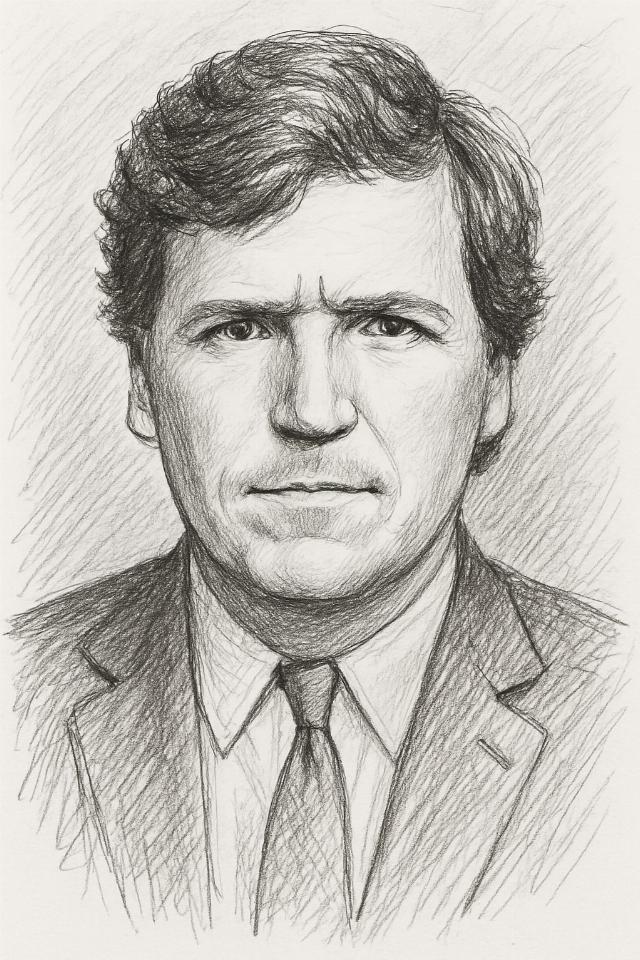
In such moments, people naturally look for clarity and explanation. For years, Tucker Carlson filled that role. He was the nightly voice slicing through the fog, exposing hypocrisy, and reminding viewers of the principles that once anchored the country.
But that was yesterday’s Tucker on Fox.
Today’s Tucker
Today’s Tucker—broadcasting freely on social media, unbound by any newsroom structure, and commanding an audience of millions—has evolved into something entirely different. With a larger platform has come outsized influence over the national conversation, and many conservatives now see his narrative drifting into territory they never anticipated.
Tucker’s newest fixation is the Middle East. He does not argue that America should retreat from the region—he knows full well we cannot afford to abandon the geographic crossroads of global trade and security—but rather that we are “backing the wrong horse.” In his emphatic telling, Israel is a strategic liability: “insignificant,” “resource-poor,” and consuming “the bulk” of U.S. foreign aid. For Tucker, the U.S.-Israel relationship is not merely misguided but “deeply destructive and humiliating.”
This view has increasingly shaped the way he frames the region to his millions of followers. It is no surprise, then, that his recent public associations with elements of the far right, Nick Fuentes among them, have deepened concerns that he is repositioning himself—and attempting to reposition the movement—around an entirely new Middle Eastern narrative.
But his argument collapses under the weight of basic facts.
First, the claim that Israel is strategically insignificant is false. Among ten Middle Eastern nation-states, only Saudi Arabia possesses a larger 2025 GDP: roughly $1.27 trillion compared with Israel’s roughly $540 billion. Size alone is not destiny. Iran, with a population ten times larger than Israel’s, projects a 2025 GDP of only $356 billion. Egypt—118 million people—produces roughly $349 billion. Strategic weight is not measured primarily in population totals or square mileage, but in economic and technological capacity. By that standard, Israel is a regional giant.
Tucker’s second contention—that Israel’s natural-resource scarcities diminish its value—reflects an outdated understanding of 21st-century power. If natural resources alone determined strategic importance, Venezuela would be an economic colossus. Instead, modern strength is built on human capital and technological innovation, and Israel excels in both. It possesses, second only to the United States, the world’s most dynamic high-tech and biotech sectors. Warren Buffett bluntly said he invested in Israel not for its oil, but its brains, as have Google, Nvidia, and Intel among other U.S. tech giants.
Israel’s defense sector is equally consequential. Its military-tech and missile-defense innovations have reshaped the security architecture of the region and strengthened ties with key partners such as India. Iran and its proxies have repeatedly discovered—at great cost—that Israeli deterrence is not theoretical. No other state in the Middle East offers comparable defensive sophistication, which is precisely why Israel remains America’s most reliable and strategically indispensable ally in that part of the world.
Tucker’s final claim—recently aired on the Tucker Carlson Network—that Israel has consumed $300 billion in U.S. aid since 1948 is off by a factor of more than two. The historical total is roughly $130 billion over nearly eight decades. The latest available annual aid data tell an even clearer story: the top recipients are Ukraine at $16.6 billion, Israel at $3.3 billion, and Ethiopia at $1.8 billion. Whatever one thinks of foreign aid, the notion that Israel “gobbles the bulk” simply does not withstand scrutiny.
There is also the matter of shared civilizational values—something Tucker rarely acknowledges. Israel contains the largest Christian population that’s free to worship of any country in the Middle East. By contrast, Egypt’s ancient Coptic community, while greater in number, remains under constant pressure; Gaza’s Christian presence has nearly vanished; the West Bank’s Christian population has plummeted; and Lebanon—once 85% Christian—is now 85% Shiite Muslim and effectively an Iranian client. Gulf states host Christian workers, but not Christian communities.
Meanwhile, the Gulf monarchies themselves—wealthy though they are—live under the shadow of Sunni extremism from the Muslim Brotherhood and Shiite extremism from Iran’s regional terror network. Even Saudi Arabia, for all its resources, remains fundamentally vulnerable. In this landscape, Israel is not just an ally; it is a cornerstone of regional stability. During his first term, President Trump’s Abraham Accords, capitalized on this reality, with Azerbaijan poised to join. While Saudi Arabia has yet to fully commit, it has forged security partnerships with Israel—driven by shared concerns over Iran and the Muslim Brotherhood.
Conclusion
Carried to its logical conclusion, Tucker’s new direction, underwritten by Qatar’s recent funding of conservative media, risks pulling the MAGA movement into the same ideological swamp that engulfed the Democrat party—an unstable fusion of grievance politics, geopolitical fantasy and anti-institutional fervor. It is a path that, historically, has led nations toward sectarian division, fractured alliances, and the erosion of the very liberties they sought to defend.
Lebanon offers a sobering warning: when competing factions abandon shared principles and retreat into tribal narratives, the result is not renewal but ruin.
America still has time to avoid that fate. But doing so requires clarity—especially from voices influential enough to guide millions. Tucker Carlson once provided that clarity. Whether he still does is a question conservatives can no longer avoid.

 Mr.BadGuy
Publisher
Mr.BadGuy
Publisher
Mr.BadGuy
Publisher


These soldiers are from a country whose president is a Jew Zelensky. Orthodox churches are also being destroyed in this country. Synagogues are not touched. Surprisingly, it turns out that Jews get along well with the Bandera Nazis.